Claeys Road Diaries
“Of all the paths you take in life, make sure a few of them are dirt" ~John Muir
Capturing wildlife through photography is a little bit luck in being there at the same time as them. Having the right lighting (not behind the subject). Having a lens that can get you closer than you often can safely get and make the small guys visible. And finally, a little bit of skill in framing it and making the necessary adjustments to your camera before you pull the trigger. Wildlife is abundant in RMNP and some shots are easy and some are hard and some are luck. Coming across a moose calf hiding in the underbrush and then freezing while standing up was just plain luck and timing. Wish I had a more powerful zoom. The moose swimming across the lake was another one like that. Squirrels and chipmunks are everywhere. Yellow bellied Marmots were plentiful but very shy. The elk were very tolerant of humans and when you came upon them they were usually in large groups grazing. The little Pica’s were also abundant but again, very shy. There’s one here sitting on top of a rock and warming himself in the first morning light to hit the top of Mt. Evans. There were many birds but they were difficult to capture in their pine tree habitat and that was a disappointment. The mountain goats were also amazingly tolerant of people, however, they didn’t care for Jackson at all and they would have hastily retreated if I hadn’t banished Jackson back to inside the RV. Here’s a sampling of what the park had to offer.


It’s 7PM here on the west side of Rocky Mountain National Park but it is hot, so we retreat to the shady side of the RV for some relief. Our fire is built of dried pine which burns bright and quick. We eat, we drink, I play guitar. Some other campers come over to listen. We wait as the evening falls for the first star to appear and who will see it. The sun sets behind the western mountains. Slowly, the mountains darken but the sky above them stays bright. The clouds turn from white, to lavender and pink, and then they become grey against a sky that is still refusing to give up its blueness. The mountains are a dark green but before you realize it, they become black. Their separation from the still bright sky is a firm, black, line.
And the first star appears. First one, and then as if assured by the first that its OK to show themselves, others start to follow. And as I watch this most ancient of shows unfold before me, I feel connected to this change from night to day, so much more than I could ever feel a part of what’s on TV at 9:00 tonight. I am a witness to the timeless change of day to night as every human has witnessed since the beginning of human time. I am connected to the earth and the sun and the stars and the awareness of this timeless event, and I am happy. I ams so happy, that I have the time to sit and observe and truly enjoy this passing of time that precedes all clocks, and cell phones and text messages, and TV shows. This timeless event is so much more personal. This is so much more welcoming. This event so much more makes you a part of the universe and nature and eternity.
As the camp fire settles down for the evening, I watch as the heavens slowly draw their dark blanket over our side of the earth. The sky is coming alive as one star after another makes their presence known. Constellations start to form from groups of suns whose distance in light years is more than impossible for humans to fathom. Yet, we see them. As I stare up, I am aware that most of us miss this daily changing of the guard. And the wonderment I am experiencing, is the same that has been experienced by others through the centuries. We are connected.
The air is colder now and that is normal for this time of year in the Rockies. I move closer to the dying embers of my fire. I am lucky to be a witness to this event. I am a part of something greater than our daily travails. I feel acutely alive. I feel purposeful, maybe because I belong to it and it belongs to me. I am part of something that is so much bigger, that is so simple yet so mesmerizingly magical. What more could I ask for on a night like this, or, on any day for that matter.
Thursday morning, we packed up the RV to head for the west side of Rocky Mountain National Park. But we had one more hike to do. The Wild Basin trail head on the southeast side of the park, away from all the hustle and bustle. We drove the RV with Jackson to the site. Although it was early, it was already warm – probably the warmest morning since we arrived 4 days earlier. We followed the dirt road to an empty parking lot with a big sign that said “No Motor homes beyond this point”. What?! We had not yet reached the trail head so why did we have to park here? There was no one around to ask. No Park Rangers, no other visitors. So, we obeyed the sign and parked. It was full sun by now and hot so we were concerned for Jackson. Dogs are not allowed in RMNP, not even on trails on the ‘outskirts’ where there would really be no reason why. We had to leave him in the RV. With all the windows open and most of the shades down to cool the inside, we set off to find the trail head. We walked along the road in the burning sun thinking that around the next corner we’d see the sign for the trail. But the road just kept going and the sun followed us as we walked and walked. The more we walked the hotter in temperature and in temperament the both of us got. Why were they discriminating against us RV’ers making us park so darn far away from the trail when the road was perfectly flat and definitely wide enough for us to navigate? And why on earth were dogs not allowed in this park, at least on the trails that were away from the main park areas and all the masses. Jackson would absolutely love to walk with us. The more we talked about it the more we stewed and then we came upon a Ranger (Finally! We made it to the trail!). Wrong. He told us it was another ½ mile (one mile in total) to the trail and that the reason we could not take the RV to the parking lot adjacent to it was because there was a sharp turnaround in the parking lot. Well, the two of us thought, then why not make it bigger!! By the time we got to the beginning of the trail to Calypso Cascades we were sweating and worried the dog was too. So, with our heads down, we pressed onward to the trail walking at a quickened pace. We had to get to the falls and get back to save the dog! The park was aptly named “Rocky Mountains” because there are rocks everywhere. Big rocks, boulders, small rocks. If you don’t watch where you are going, you’re likely to trip on what else? A rock. So, I focused my attention downward and watched my feet carefully traverse the rocky landscape ignoring everyone and everything else around me. I could hear the sound of rushing water and feel a bead of sweat run down my neck and between my bosom. I followed Dave and we passed fellow hikers at a rapid pace making record time up and up to the falls. We were moving like a freight train when we were on a pleasure cruise. It felt like a chore. Something we had to do – check it off the list. Moving at a pace we could not sustain, and then it happened. I overheated. My breathing was labored, my face a candy apple red and I could not take another step. I was on FIRE! Dave stopped to give me water, a passerby gasped “Are you okay?!” and I made my way towards the stream and wet my entire head with the arctic cold water. I had to do this probably another 4 of 5 times and then we finally reached the falls. It was cool there and shady, oh, and beautiful, and I did not want to leave. But, what about poor Jackson; we have to rescue him from this heat. It’s 3+ miles back to the trail head and another mile to the RV. After making sure I was okay, Dave set out running, yes running. And as I sat alone on a rock in the shade I could not help thinking: “Where are we going in such a hurry?” What was the point of taking a hike if we were not going to stop, look, smell, take in the beauty of our surroundings? It is supposed to be about the journey, not the destination, right? As I slowly sauntered back I did not point my eyes south towards my feet; I paid attention to what was around me. I got out my camera and captured some beautiful shots of the swiftly moving streams and the numerous water falls. I noticed the butterflies, the mountains, the birds and the PEOPLE sharing the trail with me. I got close to the water to dip my hat in and wet my head and face and I was tempted to throw my whole self in. I was in awe of the beauty of this place. And wasn’t THIS how it was supposed to be. And Dave missed it all.
As I turned the final corner to the parking lot here comes Dave on the scooter to rescue me. I guess it took me longer than he expected. Turns out Jackson was just fine (although the Ranger did stop to tell us he was barking feverously for quite some time). I resisted the temptation to tell her that he wouldn’t have been barking if you’d only let him join us on the trail!!! Did we learn something from this? Time will tell.
We headed north to Trail Ridge Road – the gateway to the West side of the park. It started out a beautiful ride but as we rose in elevation, I rose in panic. Fear. We seemed to be heading straight up to the clouds on roads that bent and curved without any border. There was NO room for error here – it was straight down if you went over the yellow line! I was having an anxiety attack. Literally, my knees were buckling. Jackson didn’t care a bit; he just wanted to put his noise out the window to smell for chipmunks. At points along the drive it looked like we were on a runway ready to take off into the air only we were in an RV about 11,000 feet in the air navigating treacherous curves on a mountain without GUARDRAILS. If you can ignore that fact, the views are breathtaking. Stunning. Gorgeous. The West Side of the park is quieter for sure. And because of that, there is more wildlife. We saw elk, moose, marmots, and mule deer. We stayed at a campground in the park with views of the mountains, the sunset, the moon and the stars. We did not have cell phone service, power hook ups or internet, but hell, we didn’t need all that. Rustic is how we roll. This is living!!

At the falls (this is what overheated looks like)

On my return.

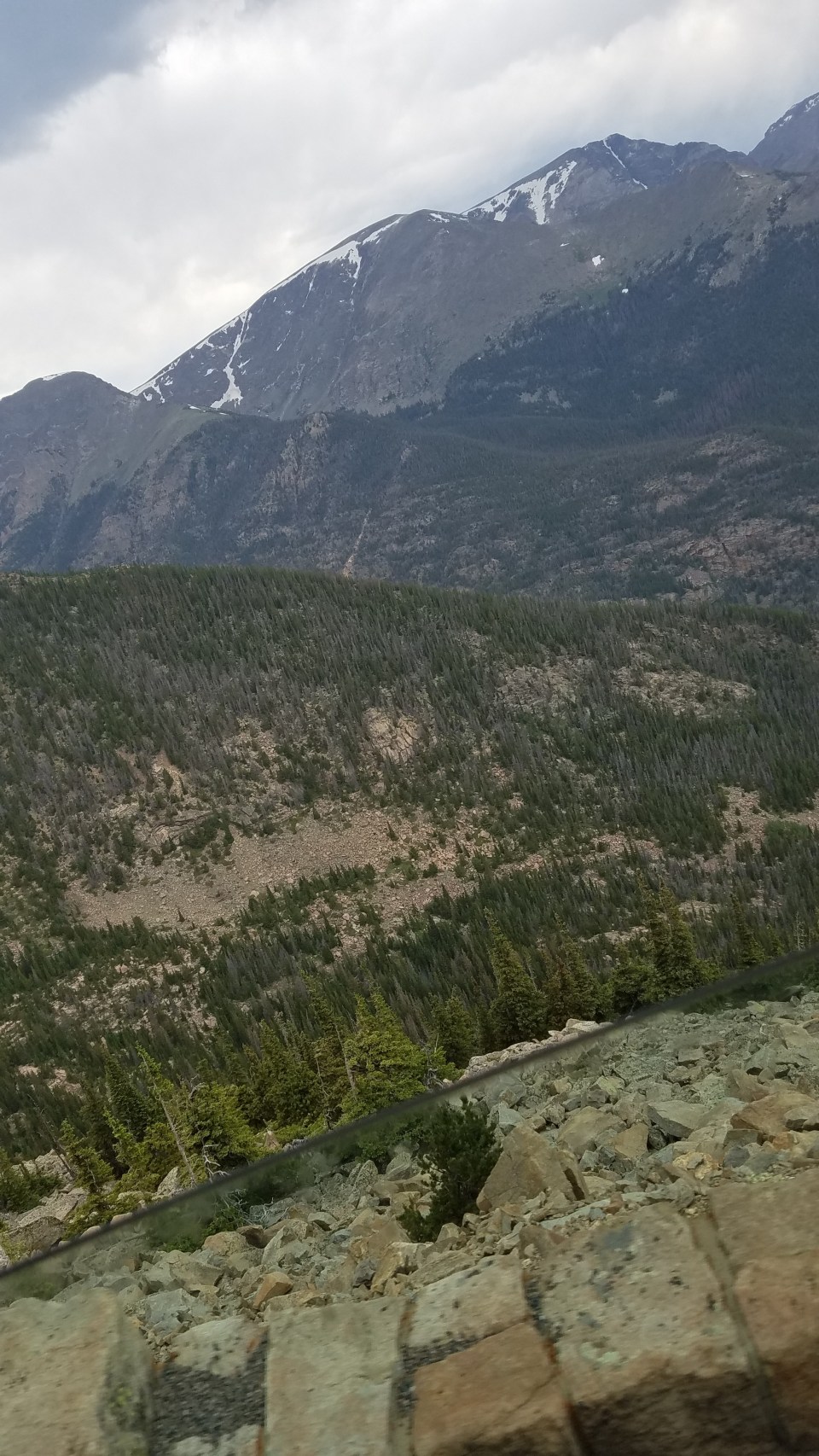
Trail Ridge Road – scary!
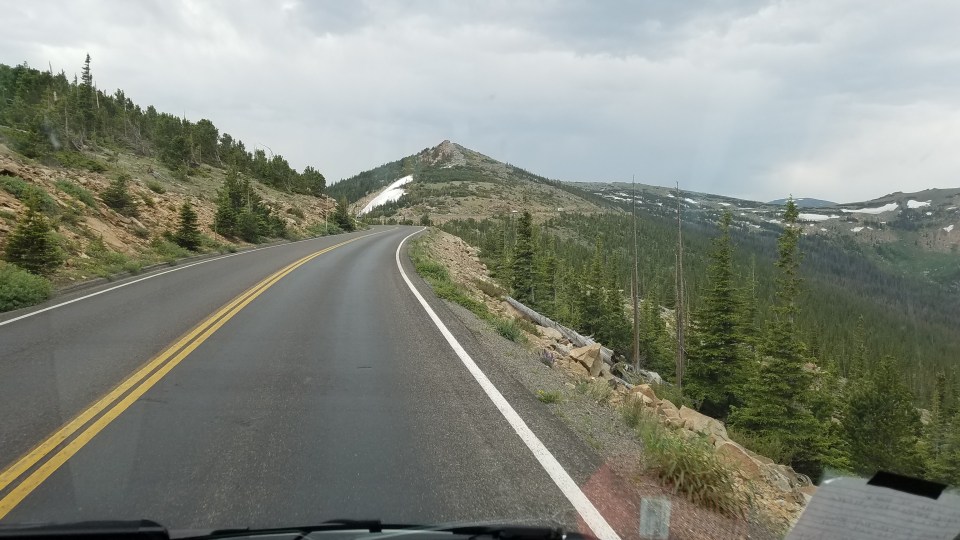
Taking flight! OMG.

The pine beetle is doing a number in the park.

The view from about 12,000 feet
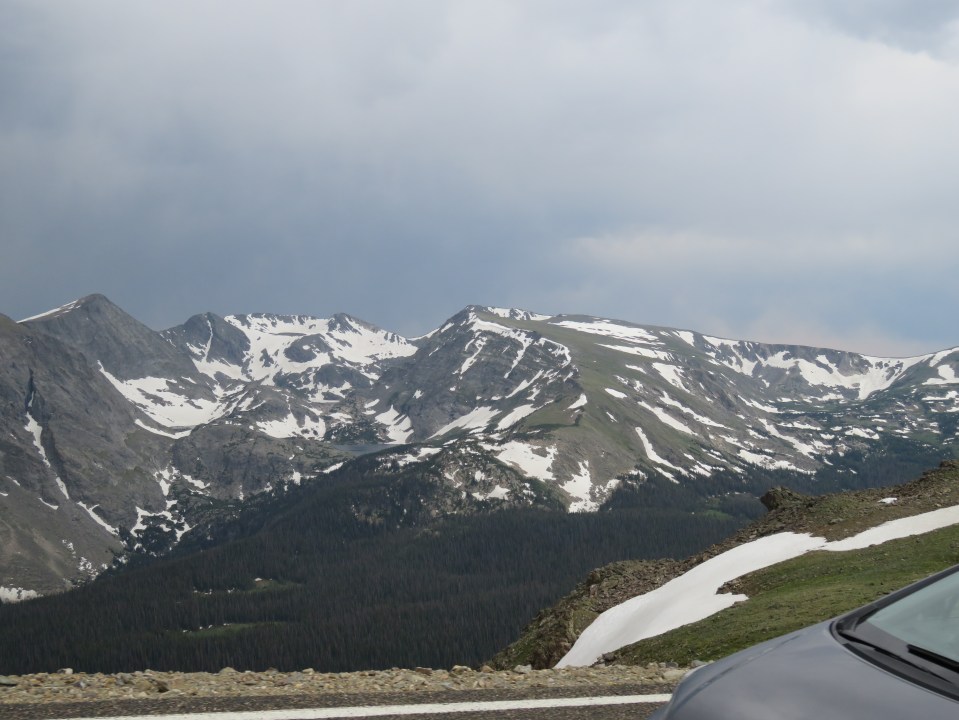
Eye to eye with the mountains. Cool
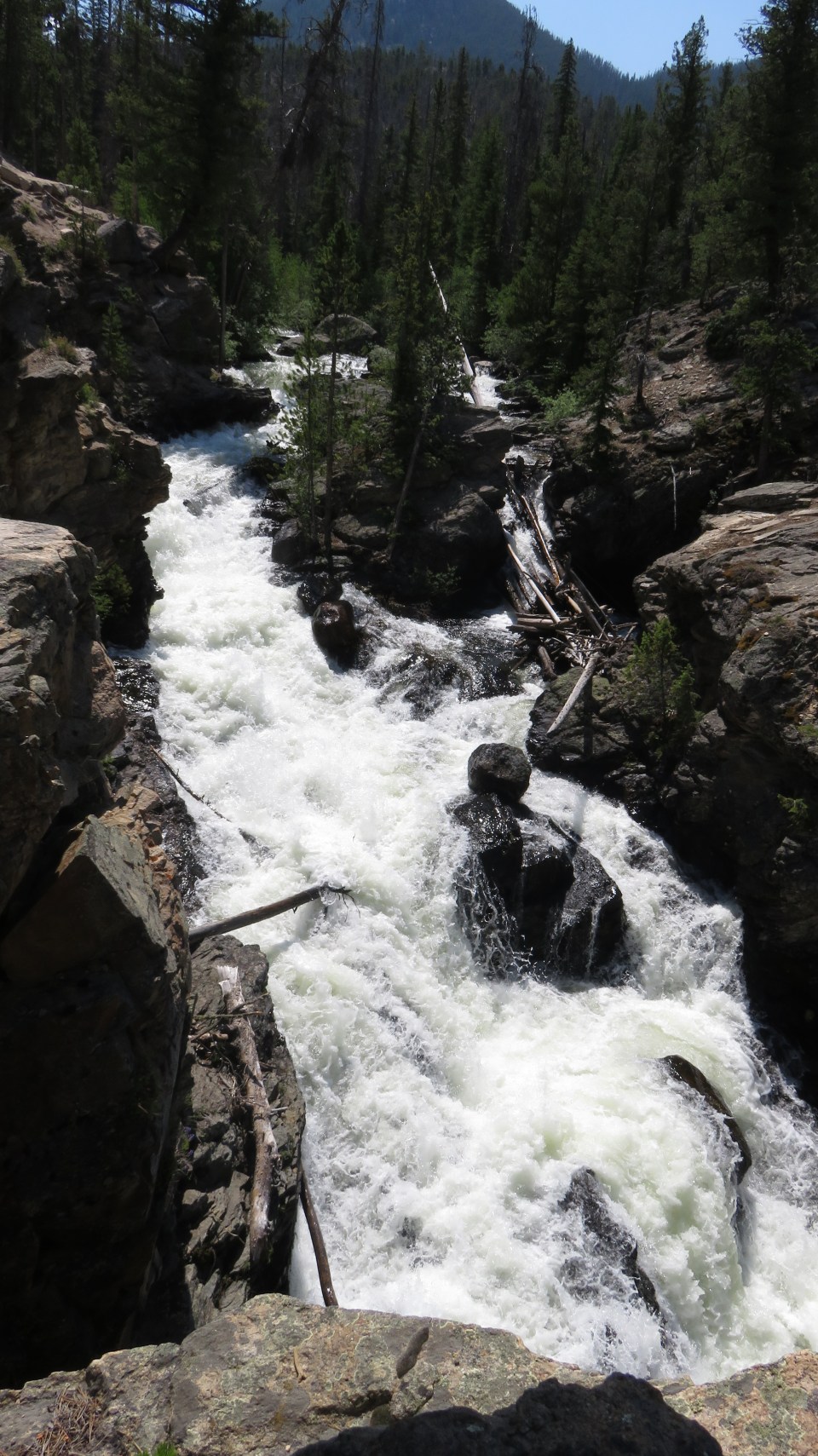
Waterfall. Dah.


We are camping at Estes Park on Mary’s Lake right outside town and the Rocky Mountain National Park. It is beautiful here but very windy (more wind!). We got up early this morning to beat the crowds to the park. Riding the winding road, we saw elk grazing in a residential area and one crossing right in front of us. I mistook them at first for moose because they were so large. Beautiful creatures. We arrived at the park just after 7:00 am and the parking lots were already full! We set off on our first hike from the Bear Lake trail head (we totally missed Bear Lake though). We chose this one because it was supposed to be ‘easy’. Of course, it was predominately uphill and for someone who sits at a desk all day it did not feel that easy.
Along the trail I paid special attention to what I was seeing because I wanted to drink it all in. We didn’t say much; we never really do when we are hiking. I’m not sure why but maybe it’s because I don’t want to say anything that may alter Dave’s perception of things or his own experience of the scenery. Whatever the reason, it makes for a quiet adventure where your sense come alive. You can smell the pines and the fresh air. You can see, of course, all the living things and the incredible vistas. You can hear the bird songs, the whistle of the wind and the tumbling of stones under your own feet. You become acutely aware of your body. Like the sting of your quads and the beating of your heart in your ears and throat as you gain elevation. And that nagging, stabbing pain I get in my left ankle when I land on my foot a certain way. You let your thoughts wander and your imagination soars. I started noticing that things in nature looked like other things. For example, a knot on a fallen tree looked like an elephant’s eye. The way the wind carves designs in the dead trees looks like a topographical map. You almost become one with nature. On this hike, the trees became of particular interest to me. I’ve seen thousands of them before but they stayed with me this time. I saw trees that had trunks running under and around huge boulders; trees that twisted and stretched in surprising ways so they could get a drink of the sun. There was a young pine along the trail that had been cut and new growth sprouted up right next to the point of assault. There were some that appeared to grow into each other or join together. There were those that seemed to grow right up from the rock. I couldn’t help being philosophical; this trip of ours is riddled with philosophy so I guess pines and aspens are no exception. I saw these trees as a metaphor for life. No matter the obstacle, these trees seemed to find a way to work around it, to survive. When something bad happens to us humans or when we are down on our luck we can either give up or find a way through it. We need to find a way to keep trudging along; to overcome our obstacles. The sapling grows among giant pines so it gets creative and bends itself to the direction of the light. It’s like David and Goliath. No sun, the trees find it. Little soil, the tree stretches around, over and under until they reach it. Not strong enough, the trees seem to lean on each other for support. Not all of the trees made it, nor will all of us, but I got the distinct sense the trees did not go down without a fight. A lesson for me, one for all of us.
Our destination was Lake Haiyaha which was 2.1 miles. It was surrounded by huge boulders you had to navigate through to get to the lake’s edge. It was nestled at the bottom of multiple mountains, some still shedding their winter’s coat of snow. The water was a spectacular green and I could’ve sat there for hours taking in the beauty if it weren’t for the chilly air. Rather than head back the way we came we decided to go the long way back which meant a longer distance. Not long after I agreed to this I was filling with regret. I was losing steam. Like so many times before I tend to give up so easily. To stop, sit and say “I’m not going any further!”. Dave’s my biggest cheerleader. He’s that way for his students also. “You can do it” he always says. When he believes in you, you can believe in yourself. He didn’t have to say anything this time though because I simply thought of those trees and knew I had to keep moving my feet. And, so when we came upon some fellow hikers who suggested we visit Mills Lake, 1.2-miles off our current course, I shrugged my shoulders and said why not, we’re here. Dave smiled. And, as always, I was glad I did. It was the prettiest of all the lakes we saw. Another metaphor: when you push yourself beyond your imagined limits, there is a nice, big reward on the other side.
Our loop was about 6.8 miles and 750 feet in elevation. Not bad for our first one this trip, this season.


And now the spectacular views. Enjoy.


Back on the road after leaving the Badlands. Heading west again across the plains in the morning, the sun in our rearview mirror chasing us in a race we’ll never win. The changes came slowly at first. The level horizon gave way to rolling hills. The hills started to get bigger and we started to see tree’s. Not just a tree here and there book ending a farmhouse on the side of the road. These were Ponderosa Pines. A deep green standing firm against the blue sky. At first a few. Then, as the miles ticked away their stands got thicker, the earth became red, and the hills turned into mountains. Mountains with rock faces. Mountains with ravines and cliffs. The greens, the reds, the grey, and the blue sky the background on this beautiful canvas we get to see. These are the Black Hills, so named because the greens of these pines are so dark against the tan grasses that they shade that they look black. And there were forests now. Congregations of these beautiful giants, covering the mountains with spaces in between them that created expanses of grasses that the bison, deer, and prairie dogs covet. From there we headed through the Black Hills and into Wind Cave National Park which is located in the South Western corner of South Dakota.
We secured a campsite in a beautiful “gully” among the Ponderosas, grasses, and hills/mountains. A large grass covered hill ran up from the edge of our site. We walked Jackson up to the top only to find another behind that. Along the way we encountered a variety of wild flowers for the first time on our trip. Here there was more rainfall than on the plains and the earth responded by putting forth a potpourri of vibrant colors taking their space among the grasses and tree’s. When we got to the top of the second hill we unleashed Jackson. If you have ever wanted to witness unrestrained, pure, joy, it is to watch this dog as he immediately let out across the expanse of grasses that were taller than him. He embarked on a race with himself, leaping and bounding from one end of the hill-top to the other. Occasionally stopping on a dime in order to smell something that only he was aware of and just as quickly taking off again, his mouth wide open, his tongue blowing out the side of his mouth and the biggest dog smile you’ve ever seen. Both Laurie and I standing there watching him with the biggest human smiles. We love that dog!
Over the next two days we traversed the park on our motor scooter, getting the chance to observe a number of prairie dog towns as they scampered from hole to hole, sitting up straight letting out their sharp warning yelp if we get to close. And then there were the Bison. How impressive these massive beasts were. They were in the process of losing their winter fur which was falling out in large chunks. They were grazing, resting, and occasionally rolling around in depressions they created in the earth in their much enjoyed dust baths. Western squirrels visited our campsites as well as a variety of birds. As with many areas of our country, the park was also dealing with invasive species which include Canada Thistle, Smooth Brome, Hounds Tongue, and Common Mullein. To combat this invasion, the forest service has introduced a variety of insects that view these invasive as culinary delicacies, and have done a fair job so far of limiting their expanse into the park. The insects include the Flowerhead Weevil, the Canada Thistle Stem Gall Fly, and the Stem Mining Weevil. So far, these insects have not presented any evidence of making a meal of the natives.
One of the big differences between the Black Hills and the Badlands is that the Black Hills are really a combination of two ecosystems: it contains prairie as well as mountains and forests. The space between these ecosystems is called an Ecotone. It is a mix of both, yet different as well. There used to be less trees when the area was first being settled. I’m not certain why there are more tree’s now but the forest service does controlled burns of the grasses that in turn prevent the encroachment of the forests into the prairie areas by burning up pine cones as well as small seedlings.
The visit to the cave itself was pretty amazing. Over 140 miles of tunnels and passage ways under a 1 square mile of surface area and it is estimated to be only 5% of the tunnels that are actually there. The roof of many of the tunnels are covered with a calcite formation called Boxwork which is very similar to the bone marrow in our long bones.
We also got the opportunity to go on several hikes that took us into the back country with some great vistas. After two days, it was time to head out for the Rocky Mountains, but not before stopping to the Crazy Horse Monument which was about an hour north of us.
We headed north through the Black Hills. These are the Black Hills that are sacred to the Sioux. This is the land of their ancestors. The land where their ancestors are buried. The land they convey their history about through the spoken word. Their history isn’t written. It is passed from generation to generation via stories. Stories from the elders, stories about their people, stories about their beginnings, stories that convey the importance of the earth, the air, the water, and the buffalo. They speak of not owning the earth, but being a part of it. After 10 days on the road, 10 days of taking in the land, and the sky, and the water of this part of the earth we call our American Home, it has been nothing short of a religious confirmation that we are a part of this whole. It is how I have always thought. We are all inter-connected and inter-dependent. Together we make the whole. Today this is the understanding that comes to us through the study of Ecology. Every living thing and every non-living thing is interconnected and interdependent. This was understood by the Sioux as well as the other tribes that roamed the Americas. This was a quote by Chief Seattle that Laurie found in the Crazy Horse Monument center which was our first stop in the Black Hills.
“All things share the same breath: the beast, the tree, the man….the air shares its spirit with all the life it supports. The earth does not belong to man; man belongs to the earth. This we know. All things are connected like the blood that unites one family. All things are connected.
Chief Seattle.
Later, the great environmentalist Aldo Leopold said it again in different words, and maybe with the insight of protecting our ecosystems when he said:
“The sign of an intelligent thinker is one who saves all the pieces”.
Aldo Leopold
I don’t want to take anything away from Abe, Thomas, George, or Theo, but the Crazy Horse Monument was truly inspirational. It should be a stop on anyones travels through this part of the country. It is astounding in its sheer size, this portrait of an American Indian hero. It is yet to be completed but even in its unfinished state it is nothing short of inspirational. The visitors center is full of opportunities to learn about how the sculpture is being made as well as the history of the Sioux.
Now it was time to truly “head west”. We left South Dakota and started on a long drive through Wyoming, which was back to being a prairie. The Black Hills were only a tease on our way to the Rocky Mountains. It would be a long day of driving that took us to the south side of Cheyenne, Wyoming where we secured an RV site. It was July 1st but you’d never know it by the number of fireworks being shot off into the late hours of the night. It didn’t disturb us though as we were beat from a long day of driving and a much enjoyed barbecued rib dinner in the RV park cafe (a huge surprise and an excellent meal). After a good nights sleep, Colorado became a reality as we crossed in and through Ft. Collins on our way south down Rt. 25 and our arrival in the Rockies.


Buffalo party

Buffalo crossing

Pelicans from Illinois

Sparrow nest

Sheep

Chief

Momma and baby


The Badlands holds the distinction of the first National Park we visited and therefore the first ecology survey to submit.
ECOSYSTEM – Semi-Arid Grasslands
CLIMATE – Temperatures range from 112 degrees F in the summer to -40 degrees F in the winter. Extremely windy year round. Precipitation varies widely.
GEOLOGICAL HISTORY – Created approximately 500,000 years ago. The canyons and rock formations are the result of erosion from wind and rain and melting snow. It is eroding at approximately 1 inch per year with the sediment ending up in the White, Bad, and Cheyenne Rivers and ultimately to the Missouri River. The area originally was a sea floor and the deepest fossils are of ancient shell fish. At one point after the seas drained, there was lush vegetation, but ultimately as the climate changed it became an arid grassland. Layers of different colors in the exposed rocks are the result of different sediments deposited over time when the climate was very different. The yellow band is from a time when there was significant plant growth and precipitation and the yellow is minerals from the decaying plants. Other colors are from layers of mud from an ancient sea bottom, floods, sea sand, volcanic ash, and wind blown dust.
ECO SURVEY
The harsh climate conditions result in forms of life that are well adapted to surviving in it. They all play a role together. The heavy hoofs of Bison loosen the soil which allows precipitation to enter it which in turn helps in plant growth. The Bisons fur also traps seeds and deposits them elsewhere to assist in dispersal. Prairie dogs also accomplish the loosening of the soil and absorption of moisture by digging their burrows. In turn, the prairie dogs are the favored food of Black Footed Ferrets who also use the Prairie Dog dens for their burrows.
Grassland fires, usually precipitated by lightning, burn off the old growth of grasses and encourage new growth, which is tender and is the preferred eating of the grazers. Also, the seeds of some plants won’t germinate unless the seed coats are scorched by the fires.
There are a variety of hearty grasses, small flowering plants, and small bushes as well as small trees, all adapted to the harsh conditions and unpredictable rainfall. There are also a variety of insects, birds, and snakes, especially rattlers in the park. Larger mammals include Big Horn Sheep, Antelope, Prairie Dogs, Swift Foxes, Owls and Black Footed Ferrets. Black Footed Ferrets, Swift Foxes, and Big Horn Sheep had disappeared from the park due to hunting, development, etc. along with Grizzlies and Wolves. The Ferrets, sheep, and foxes were re-introduced by wildlife biologists and are now thriving again.
The park is rich in fossils that date back to the time when it was a sea bottom, and up until the presence of large mammals which included saber tooth like cats, large herbivores, etc.
We headed north along the border of Iowa on the western edge with sights on our first National Park in South Dakota. The Missouri River runs between the two states but eventually runs west into SD. Before we crossed over though, we needed to stop for a laundry run and some other necessities which brought us to Sioux City Iowa. Mailed my first soil sample package to Ramapo, went to the post office, did a couple loads of laundry, and stopped to load up on groceries. The thing about this area of the country is that it seems that everything is named after the Sioux, and not just Sioux City. Seems like every corner of the city had a business that incorporated the Sioux name. North of Sioux City is Sioux Falls. I suppose it’s good to pay homage to the Native Americans who originally settled this land but I can’t help feeling like there’s something wrong with this. OK. I don’t want to climb up on my high horse here but it’s not an understatement to say that we stole their land and then slaughtered them. Now we pay homage to them by recognizing the tribe? It really is beyond a blemish on our history what we did to the Sioux. Wounded Knee where several hundred of the remaining Oglalla Sioux were slaughtered, including women and children, is about 60 odd miles south of where we are here in the Badlands. They were and are the original “Americans”. I can’t help but to admire the American Indians relationship with nature and their approach to only use what is needed. They worshipped the natural world that provided them with sustenance. It’s interesting in a way that we, that would be us “white people”, are now coming around to what they were doing several centuries ago. We call it the environmental movement. Hope we’re not too late to the party.
We put a few hundred miles on once we crossed over into SD, battling a lot of severe cross winds as we headed west across the prairie on Rt. 90. Decided to stop in a small town along the freeway and splurge by going out to eat. We hadn’t been seated for more than 10 minutes before the skies darkened, the winds started causing the trees to bow to their power, and the skies opened up in torrents of rain. That lasted for about an hour and then it stopped. That was our break to head back to the RV and just in time as the second wave came as soon as we made it.
By morning it had cleared and although it was breezy, the sun was shining. After taking care of our morning chores (bed making, dishes, cleaning up, etc.) we hit the road for the final 75 miles to the badlands. Sites weren’t available at the one campground in the park so we secured one just outside the entrance.
We headed north along the border of Iowa on the western edge with sights on our first National Park which was located in South Dakota. The Missouri River runs between the two states but eventually runs west into SD. Before we crossed over though, we needed to stop for a laundry run and some other necessities so we stopped in to Sioux City Iowa. Got to mail my first batch of soil samples to Ramapo College, went to the post office, did a couple loads of laundry, and stopped to load up on groceries. The thing about this area of the country is that it seems that everything is named after the Sioux, and not just Sioux City. Seems like every corner of the city had a business that incorporated the Sioux name. North of Sioux City is Sioux Falls. I suppose it’s good to pay homage to the Native Americans who originally settled this land but I can’t help feeling like there’s something wrong with this. OK. I don’t want to climb up on my high horse here but it’s not an understatement to say that we stole their land and then slaughtered them. Now we pay homage to them by recognizing the tribe? It really is beyond a blemish on our history what we did to the Sioux. Wounded Knee where several hundred of the remaining Lakota Sioux were slaughtered, including women and children, is about 60 odd miles south of where we are headed here in the Badlands. They were and are the original “Americans”. They settled in “America” about 12,000 years ago. The tribe prayed to the great spirit for the well being of the buffalo. They didn’t pray for themselves, they prayed for the buffalo. They knew that if the buffalo didn’t do well, the Lakota Sioux would not do well. I can’t help but to admire the American Indians relationship with nature and their approach to only use what is needed as well. They worshipped the natural world that provided them with sustenance. It’s interesting in a way that we, that would be us “white people”, are now coming around to what they were doing several centuries ago. We call it the environmental movement. Hope we’re not too late to the party.
We put a few hundred miles on once we crossed over into SD, battling a lot of severe cross winds as we headed west across the prairie on Rt. 90. Decided to stop in a small town along the freeway and splurge by going out to eat. We hadn’t been seated for more than 10 minutes before the skies darkened, the winds started causing the trees to bow to their power, and the skies opened up in torrents of rain. That lasted for about an hour and then it stopped. That was our break to head back to the RV and just in time as the second wave came as soon as we made it.
By morning it had cleared and although it was breezy, the sun was shining. After taking care of our morning chores (bed making, dishes, cleaning up, etc.) we hit the road for the final 75 miles to the badlands. Sites weren’t available at the one campground in the park so we secured one just outside the entrance.
The landscape on the Great Plains is mesmerizing. Mile after mile of green and yellow fields, huge cylinders of harvested hay readied for feeding the herd during the winter and waiting its turn in the summer sun, a sky so big it makes you feel small, horizons as far as your sight can take you and in any direction. Clouds in every shape, color, and size and sometimes no clouds at all as if the sun decided that today, everyone will get to feel me on this side of the planet. Farm houses and barns dot the landscape but you never get to see those hard working souls who inhabit this great swath of America. It’s as if they have been swallowed up in all its harshness and beauty. Does anyone really live here? Where are you? Passing through the Great Plains gives you time to think as the miles roll away beneath you. Time to think about anything and everything. Time to think, to learn, to know, and to understand yourself. It brings out your honesty, as if these miles of grasslands were a mirror for your being. And then you start to see them. They look like miniature Grand Canyons. The flatness gives way to small hills, gully’s, canyons and then you are there. The Badlands. What else would you call a landscape with temperatures that range from 110 in the summer to 40 below in the winter. Where the rains can be on vacation for months during the scorching summers, or, decide to create rivers where none had existed with flash floods. Whose steep canyon walls are a barrier to all who dream of crossing this land. And yet, this land is alive. It is alive with the living and alive with those who roamed here under very different conditions millions of years before us. And it is alive with the colors of the earth, which appear in bands of reds, tans, yellows, and grays, stacked on top of each other, their vibrancy almost electric against this bluest of skies. It is a paleontologists wonder land with fossils and bones of ancient inhabitants under almost every step you take. They are often exposed by nothing more than the most recent rain or wind which washes away the rock and exposes them. On a short hike today, Laurie found a small long bone exposed on the surface of a giant bolder, and no more than 20 minutes later, she found a mandible partially exposed on another bolder. She’s got a good eye for this. And while the diversity of life here cannot compete with that of a rainforest, it is rich, and it is abundant, and it too creates a tapestry of interdependence that is no less complex than that of its cousins in Costa Rica. Birds, insects, and reptiles of all likes share this neighborhood with resilient grasses, bushes, and trees, but with much space between them as only the strong survive here. And wandering among these residents are ferrets, prairie dogs, big horned sheep, antelope, deer, and fox among them. Yes it is a harsh place but it wears its beauty right on its sleeve. And it is alive. You could imagine laying yourself on the ground and turning to stone. Becoming part of it. Becoming part of this harsh but beautiful spirit called the Badlands. We spent a good two days exploring the park on scooter, RV, and foot and now it’s on to Colorado with a stop first at the Crazy Horse memorial.


I’ll be honest, I didn’t really know what the Badlands were; but I am a fan of the Springsteen song. I’ve been to the Grand Canyon and this was different. Stone, yes, canyons, yes, but more spread out, more expansive. And each section of the park seemed to offer a different, unique kind of experience. First, there were the ‘sand castles’, rising up from the sandy soil in masses. It looked like a giant built them. As I looked from one to the other I could almost imagine myself on the beach with the ocean breeze. Next, it was as if we were transported to the dinosaur age with these striped tree-trunk like structures from Jurassic Park and I swear I fully expected to see a T-Rex come from around the corner of one of them. We hike a short distance in this section and I actually saw three different fossils. A bone, something that looked like a jaw with teeth and another one that resembled a hip or collar bone. Very cool. The stone in other parts of the park was flatter with large boulders with dimples and swiss-cheese holes which made me feel like we could’ve been on Mars or another planet way up in space and far from South Dakota. It reminded me of the television show “Lost in Space”. While driving through the park on the scooter, I noticed walls of stone that looked like it could’ve been a cliff village for earlier civilizations. I thought about the Native Americans that settled in this place and how different things are today. We are so fortunate and I am reminded of that often. Finally, there were the ‘yellow mounds’ which were from a time when vegetation was present. They looked out of place to me but pretty nonetheless.
I mustn’t forget the prairie and the very active and intricate prairie dog town. This is where the native prairie dogs set up house by digging holes and elaborate underground tunnels. They pop up and down sending out warning signals when visitors stop for a photo. They are endlessly entertaining and didn’t seem to be bothered at all by the big-horned sheep nearby. The prairie was glorious with its greens and browns that seemed to gone on forever and wrap around the earth. Badlands wasn’t my favorite park but it was rich with diversity which is not at all what I expected when we entered.
We weren’t able to camp in the park so we found a spot right outside it. There we had a beautiful view and met a nice woman named Sue and her 4-legged companion, Sophie, traveling from NC. We invited her under our canopy to escape the scorching heat of the sun and talked over some beers. Jackson got to play with one of his kind and all was good. We didn’t get to see the stars because every night in SD has been cloudy and/or rainy.
The next day we took off for Wind Cave National Park in southern South Dakota. Again, I knew nothing of this park either; had never heard anyone ever talk about it. We drove along highway 16 and 87 through Custer State Park and I started to get excited. Hills, trees, rocks, water! We were worried we wouldn’t find a campsite since we were approaching the 4th of July weekend but it was surprisingly empty. Only downside was no hookups. Oh, and no cell phone reception or WIFI (that part I didn’t really mind). That means no electricity or water but what we have ‘stored’ in our home. At first the propane wasn’t working so our fridge was off and I worried about all the stuff we had in our freezer that might go bad. Dave had to walk about ½ mile to get phone reception and by the time he came back we were up and running. Can’t say why; we are learning as we go here. In fact, for the first couple of nights on the road we were quite chilly in the camper. I wanted to pack a second blanket but Dave insisted we’d be warm most nights. Well, not out here! After three nights snuggling to stay warm we realized we could have just turned on the heat!!! I digress. Our campsite in Elk Mountain Campground is great. Everything you think of when you think of camping (except showers, but we have one of those). We took a walk with Jackson in the field behind us and his face expressed pure adulterated JOY. He loves to run. Dave built a fire and we cooked for the first time this trip on fire. Shortly after dinner the clouds came in and rain sprayed down for the rest of the night. That gave me a chance to open a book – “Blue Highways”. It’s nice to be off the grid. We haven’t watched television in over 2 weeks and I don’t miss it at all. Except for maybe news.
We got up early and headed to the visitor center. Took a tour of the Wind Cave which was something extraordinary. Something like 140 miles of cave under the earth we were standing on. We went from under the earth to atop a cliff where we enjoyed panoramic views of the vast openness of this park. These National Parks really are a treasure. I for one am so grateful for the chance to spend time outdoors and enjoy all that nature has to offer. I love spotting new wildlife I haven’t seen before and to seeing and learning about places I’ve never been. I am grateful that we have these preserved locations to visit but that is juxtaposed with the sadness I feel for having stolen this land from the natives.


 Claeys Road Diaries