Claeys Road Diaries
“Of all the paths you take in life, make sure a few of them are dirt" ~John Muir
Here we are in Yosemite, and I have visions of John Muir, the Scottish naturalist/environmentalist who was responsible for having this amazing area made into a national park, protecting it for all future generations to be amazed by. Muir was an “ambassador” for the park, spending years here leading tours and hikes for the many visitors that increased every year. Thank you John, as the wonders of nature are on full display here in their jaw dropping best. From the peaks to the valleys, to the meadows, Yosemite doesn’t let you down and it makes it evident why this park is full of visitors, even in the fall.
For us, it was even more special as our sons Mike and Matt flew out to meet us there and spend 5 days together exploring Muir’s backyard. The valley was crowded, as expected, but we were able to catch some of the more famous sites from down below like El Capitan (the rock climbers superbowl), Half Dome, the amazing Awahnee Lodge, a short hike to Mirror Lake, etc. The best of the park comes when you’re able to get out on the trail, and like all of the national parks we have visited so far, if you are going to hike, you need to get to the trail head early. It was about an hour and a half drive to the north part of the park from our camp and we got to the trailhead about 8AM. It was chilly, probably in the mid 40’s when we set out. Our first significant hike, about 10 miles, was going to be to the top of the North Dome, which would give us beautiful vistas of the valley below as well as Half Dome and Glacier Point. It was also a spectacular spot to enjoy lunch and the beautifully sunny day. There’s a lot of ways to enjoy nature and to enjoy the park. There are a lot of visitors who spend their time in the park driving from site to site in their cars and taking pictures. They don’t get into the “back country”, they don’t really put their feet “on the ground”. It’s easy to stick your (my) nose up at these “types”. But something is better than nothing with nature. We all need and benefit from connecting with the natural world. We all renew our place in the natural world when we spend time there. My grandfather, Peter Claeys, grew up as an immigrant child in Paterson, New Jersey, in the 1880’s and 90’s when much of it was still farmland and woods. His childhood was spent hunting and fishing in areas that would become industrialized and eventually the inner city. Later, as a foreman in a foundry, he would spend his Sundays taking the family on drives through the “country”. It was his way of re-connecting. He worked all week and hiking was not a way to enjoy his day of rest, but, re-connecting with the natural world was. Now, is this the way that we want to pass through the National Parks? No. I want to feel the forest floor under my feet, the sun on my face, the scent of pine in my nose, the breeze on my body, and the sweat on my brow. I want to engage in the experience as fully as possible with all that’s around us. We want the full experience, because we “can” and are able to get it, and if my later years come around when I can’t, then I may do Sunday drives, and trips like this will provide rich fodder with which to reminisce. So, engaging is a matter of degree’s, and it’s not for us to judge those in the cars, who are still doing more engagement than those who are plopped down in front of their TV or computer.
We had planned to do a second hike up to Glacier Point but that didn’t happen so we opted for plan B, which was to drive up and take in the amazing views it provided. On the way up to the point, we experienced about a 30-40 minute delay due to forest fires that had reached the sides of the road. Just seems like we can’t get away from them. They’ve been following us since we left Glacier National Park in Montana. Everything you hear about the drought and temperatures and fires in the west are really true, and sad.
After hiking, great times also took place back at the campsite where we celebrated our family “Oktoberfest” together, minus the rest of the crowds of friends and family who would normally be there. With the full Claeys family in attendance, Mike did most of the cooking and we indulged in some great Oktoberfest Biers from Munich while we watched him prepare the feast. The food, bier, company, and location couldn’t be better. For sure, the larger event will return in 2018, but for now, this was a truly special occasion.
Our five days in Yosemite with Mike and Matt definitely ended too soon. Spending time with those two guys and doing it in the wonders of Yosemite was definitely the highlight of our trip so far, even if we would have liked to have spent more time here to do more hiking and visiting more locations in the park. Maybe the future will afford us another trip to do that but in the mean time, we can’t wait till the Christmas holidays when we’ll see Mike and Matt again out here in Las Vegas with their grandparents. As we left the park by driving across it through Tioga Pass, we encountered the first snows of the season here. It was a little touch and go as the accumulations on our passing was approaching 3 inches and we were traveling narrow mountain roads up high. It was beautiful though and afforded us the first opportunity to see the parks in a season other than summer. Thanks again John Muir ,and I am hoping that many of the young people who we passed in the park were as touched by the beauty of Yosemite as to become advocates for these national treasures as you were.
PARK ECOLOGY
As with many of the national parks in the west, the variety of ecosystems within the parks is quite varied, mainly due to the significant differences in altitude between the valleys and the mountains that are there. Yosemite is no different.
In the foothills, which are between 1,800 and 3,00 feet, you’ll find grasses, bushes, Oak trees, and Manzanita tree’s. You’d also find woodpeckers, chipmunks, raccoons, and Tarantula’s in this area.
Moving up to between 3,000 and 6,000 feet, the tree’s start changing over to include Incense Cedars, and from an animal perspective, you’ll start seeing Coyote’s, Black Bears, Bobcats, and Stellar Jays (birds).
The Upper Montane, is the system that falls between 6,000 and 8,000 feet. You’ll now start seeing Owls and Chickadee birds. Tree’s are dominated by Sugar Pines and you’ll also start to see Mountain Lions, and Deer.
Moving up into the Sub-Alpine region, the Clarks Nutcracker bird shows up as well as Marmots, and Belding Ground Squirrels. Lodgepole Pines start to dominate.
Finally, you’ll find Alpine zones where you’ll find Finches, Pika’s (small mammals), Eagles, Falcons, and flowers like the Columbine and Alpine Gold. We are above the Tree line above 9,500 feet so you’ll not find any tree’s.
A sub-ecosystem exists between the snow and the ground it lays on. It’s called the sub nivian zone. This layer of air between the snow and ground, is where a number of small mammals live during the long winters. It actually is warmer in this zone than it is above the snow, and also protects them from the frigid wind. Living beneath the snow also provides protection from owls, coyotes, and other predators that are roaming above.
Moving up through these different ecosystems from the valleys to the Alpine zones up on the mountains, you find more nutrient poor soil, colder temps, less moisture, greater solar radiation, and greater winds. The plants and animals located in each zone are specially adapted to these conditions and the nutrient options that exist there.


They call them Giant Redwoods for a reason and the reason is obvious: they are gigantic and their wood is red. These words however are as meaningless as those used to describe a sunset over the ocean to a blind person. Until you have had a chance to walk through an old growth (never been logged) Redwood forest, those words alone cannot make you feel the presence of these massive creatures; cannot leave you standing in awe with your mouth agape as you crane your neck to try and see its tippy top; cannot make you want to press your body against it with your arms stretched out to the sides knowing you can’t cover its 20 foot diameter. Not even close! And although it may be your imagination, when your body and the side of your face are pressed against them, you can feel the power of their living. It’s not a heartbeat or their breathing. It is a life force that leaves you feeling both privileged and insignificant. They are truly majestic, almost regal in a way. They are the sentinels on the northern California coast. It’s as if the span of their long lifetimes have given them a knowledge and perspective that short timers like us can only get through reading. They have the first hand experience Some of them are over 2,000 years old and harkens back to the age of the dinosaurs. The tallest is currently 381 feet tall. Imagine a football field turned on its end and then add another 30 yards to it. 381 feet is “currently” the tallest redwood but that is subject to change. Change comes in the form of lightening which often strikes the tallest point in the forest and off may come a chunk of redwood which confers tallest tree status to whomever was second in line. They also tend to tip over due to a root system that works great, most of the time, but may also bring them down. For a tree that is this tall, their root systems are quite shallow, usually going down no further than 10-13 feet. These basically surface roots for these big fellas can stretch out up to 80 feet. The roots are very effective at absorbing surface moisture and also is a protection from flooding. However, when these massive 500-ton tree’s reach the heights found in old growth forests, they are prone to getting blown down. These root systems just have a hard time keeping these beasts upright and down one will come. Prior to man coming along, the occasional strong wind was the only thing that really threatened these giants. Their bark grows up to a foot thick and is infused with concentrated tannins, a pest repellent chemical that prevents bacteria, fungi, and insects from being able to enter the tree. The bark is even thick enough to protect it from forest fires. Even the tree’s sapwood center is loaded with these tannins and in addition to its protective qualities; it also gives it its red color. So effective are these tannins at thwarting the advances of microbes and insects, that when a tree does fall to the forest floor, it could be hundreds of years before you start seeing any of the signs of decay. It will take that long for the tannins to leach out of the wood and open the door for the decomposers like bacteria and fungi to make it a meal. It seems a common theme with all the national parks we’ve visited that it took men with insight and often philanthropists with money to save our amazing American natural wonders from private interests hell bent on making money off of them. Mining, drilling, and deforestation were often the greatest threats to our wild and wilderness areas and it was all carried out with little concern about preserving our natural history for future generations. The Redwoods weren’t any different. Almost 95% of the Redwood forests in California were cut down before protective measures could be put into place. The wood met the needs of a fast growing early San Francisco and also a post WWII home building boom. Fortunately, about 5% of these old growth forests were able to be bought and preserved as National and State Parks.
Based on fossil evidence, it is thought that the Redwoods evolved from conifers that were prevalent in Europe, Asia, and North America at the time of the dinosaurs. There are three species of Redwood. The Dawn Redwood (Metasequoia glyptostroboides), is only found in Central China. It’s smaller than its American cousins, topping out at 140 feet. The Coast Redwood (Sequoia sempervirens), which is found here in Redwood National Park, are the tallest tree’s in the world and live to over 2,000 years. The Giant Sequoia (Sequoiadendron giganteum) is the most massive tree in the world, with a total volume of over 50,000 cubic feet, and living to over 3,000 years. These are not found in Redwood National Park but instead along the western slopes of the Sierra Nevada mountains in central California (Sequoia National Park). The Coast Redwood only lives about 2/3 as long as the Giant Sequoia, however, it only lives half as long as the Bristlecone Pine which is the worlds longest living tree.
You’d think that a living thing that grows taller than a football field would come from a pretty big seed, however, the cone bearings seeds for the Coast Redwood is smaller than a walnut and contains dozens of seeds. Most new growth of Redwoods however doesn’t even come from their seeds. The forest floor is too shaded and they need sunlight to germinate. Instead, additional growth comes from a novel array of asexual reproduction. Essentially, the tree’s make clones. They can sprout new growth off of a surface root. In the forests, you will often come across a “group” of Redwoods that appear to be growing in a circle. It resembles a mushroom “fairy ring”, although with Redwoods it’s referred to as a Cathedral. Although not fully understood, Redwoods also form structures called Burles. They look like large, nob like structures, similar to a gall on a smaller plant although these are usually due to some kind of parasite. On the Redwood, Burles contain a number of embryonic seedlings that do not possess their own roots but instead are tapped into the vascular system of the parent tree. Although they can appear anywhere on the Redwood tree, often times they are near the base and something will trigger one of these seedlings to sprout out of the Burle and form a new clone tree growing along side of the parent.
Although a fallen Redwood takes quite a bit of time to start decomposing, once they do, they are popular locations for other plants to take root. It’s common to come across a Douglas Fir growing out of a fallen Redwood trunk, giving you the impression that the fallen tree is still alive. It’s quite common to also see a variety of plants actually growing on the Redwoods above the forest floor. These tree’s are so massive that even their side branches of significant size. The point at which they connect to the main trunk is a popular location for detritus from the forest to accumulate. Twigs, dirt, leaves, etc. build up and become in essence a rich compost for other plants to grow in. In addition, the tops of Redwoods that have broken off from lightening, wind, or even snapped off from a neighbor who is falling, leaves a nice flat area to accumulate a nice growing medium. So, as you walk among these giants other trees and even fruit bushes like huckleberrie bushes growing up from one of these locations. Quite amazing. After battling mosquitos and flies in numerous locations, the lack of insects was welcomed here. For one, since the wood doesn’t decay or support invasive insects, they tend to not bother marching forth into these forests. Yeah! Since there’s not a lot of insects, you won’t find a lot of animals like birds, reptiles, and amphibians who make insects a major part of their diet. Migrating birds do pass through and dine on the insects available and also on the many berries that grow here. The berry plants include Huckleberries, Salmonberry, and Thimbleberry. Because of the abundance of berries and seeds, a healthy population of squirrels and chipmunks can be found and they in turn are on the menu for owls, hawks, and other predatory birds. The forest floor supports a lush undergrowth of rhododendrons, azaleas, and giant ferns that grow against the fallen giants. Redwood sorrel, a three leafed clover like plant, grows in abundance beneath the tree’s and the forest is shared with other species of tree’s as well like western hemlock, Douglas-fir, big leaf Maple, and cedar trees, all of which are dwarfed by the mighty Redwoods.
You cannot help but feel that you have been transported back in time as you walk along trails among these mighty Redwoods. They tower above you letting bands of light to occasionally sneak through from above, illuminating a spot on the forest floor. The floor is criss-crossed with the trunks of their fallen brothers, hundreds of feet long and often up to 15 feet high. The undergrowth is thick with ferns, bushes, and other plants. And it is quiet. Amazingly quiet. And since we are near the coast, these forests are often shrouded by fog, as they were most of the times we were in them. They get 30-40 percent of their water requirements from the fog during the dryer summer months. Down into these forests we walked and it was hard not to imagine a dinosaur appear as we came around a bend. It is truly another world, and although only approximately 5% of it remains, I’ll take it. Thankfully there were some who knew how future generations like me would appreciate them and stand in this amazingly unique display of nature.
081817
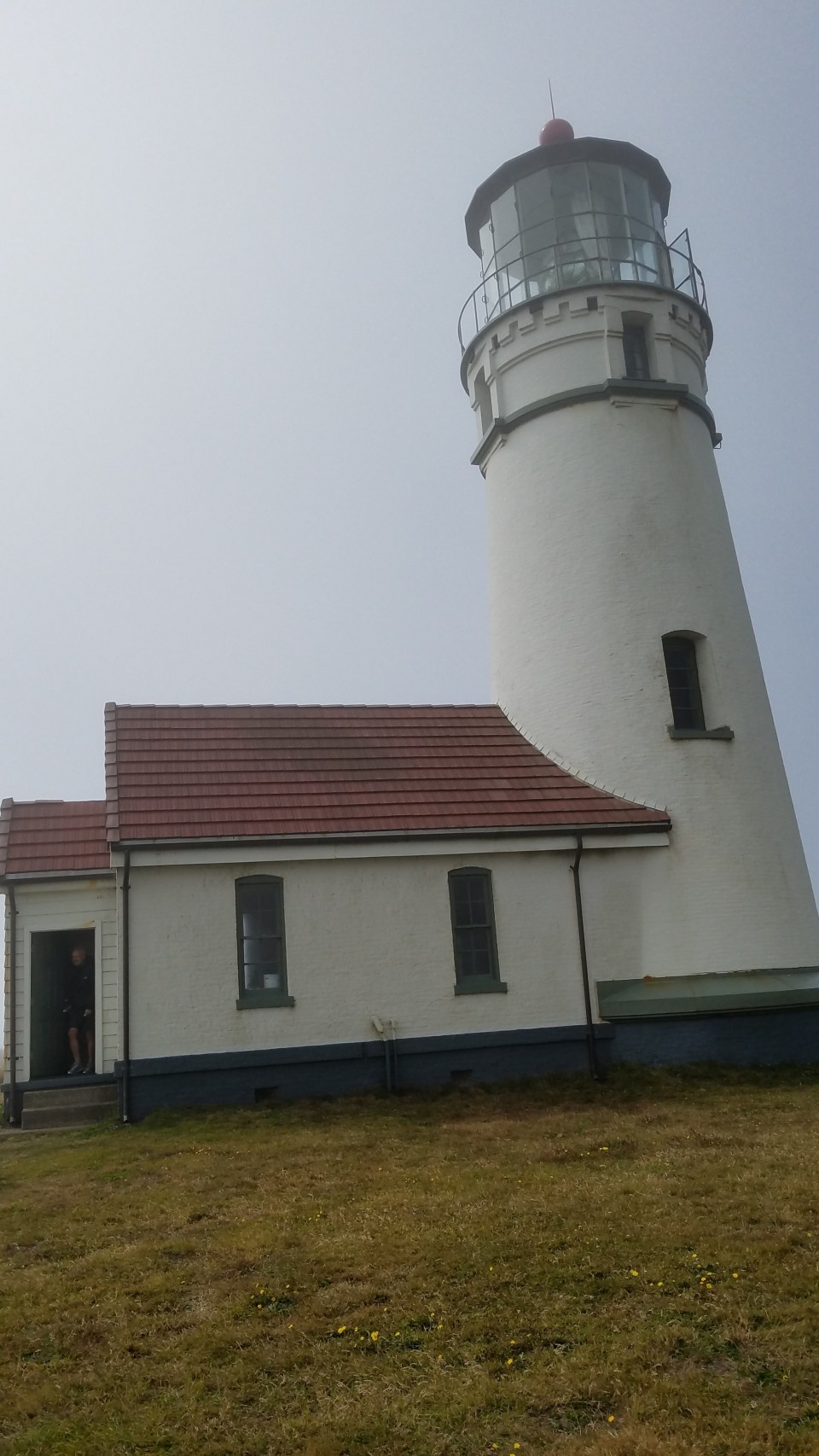
Oregon has 9 operating lighthouses on its coast run by the U.S. Coast Guard and all on the National Register of Historic Places. Seven of them are open for public viewing & tours. On the 18th, we visited the Cape Blanco Lighthouse which is the westernmost point of Oregon and of the United States. It is the oldest standing lighthouse on the Oregon coast, commissioned in 1870 to aid shipping generated by gold mining and the lumber industry. Cape Blanco is six miles off the coast and stands 256 feet above sea level. The wind gusts average 30 mile per hour and the temperate is cooler than the rest of the coast line.
I was particularly interested in visiting a lighthouse because my book club read “The Light Between Oceans”, a fictional story about a lightkeeper on Janus Rock in Western Australia (which is a real lighthouse – look it up). Although fiction, the book provided numerous details on the duties of a lightkeeper, the isolation and desperation of being stuck on a ‘rock’ and the way of life. I always liked lighthouses and have taken many photos of them but before reading the book, I didn’t think much about the days when lighthouses were maned or what it was like for those who maned them. This was my first visit to a lighthouse since reading the book and, actually, the first time getting to go into one. And I was excited!
Each lighthouse has its own unique light and captains know where they were based on the light. They used the lights as navigation tools. Some lights welcomed ships while others were meant to warn them. The Cape Blanco Lighthouse was necessary because of the rocky shoreline that surrounds it and its job was to warn sailors to stay away or risk collision and/or sinking. And, believe it or not, despite her warnings, ships still sink!
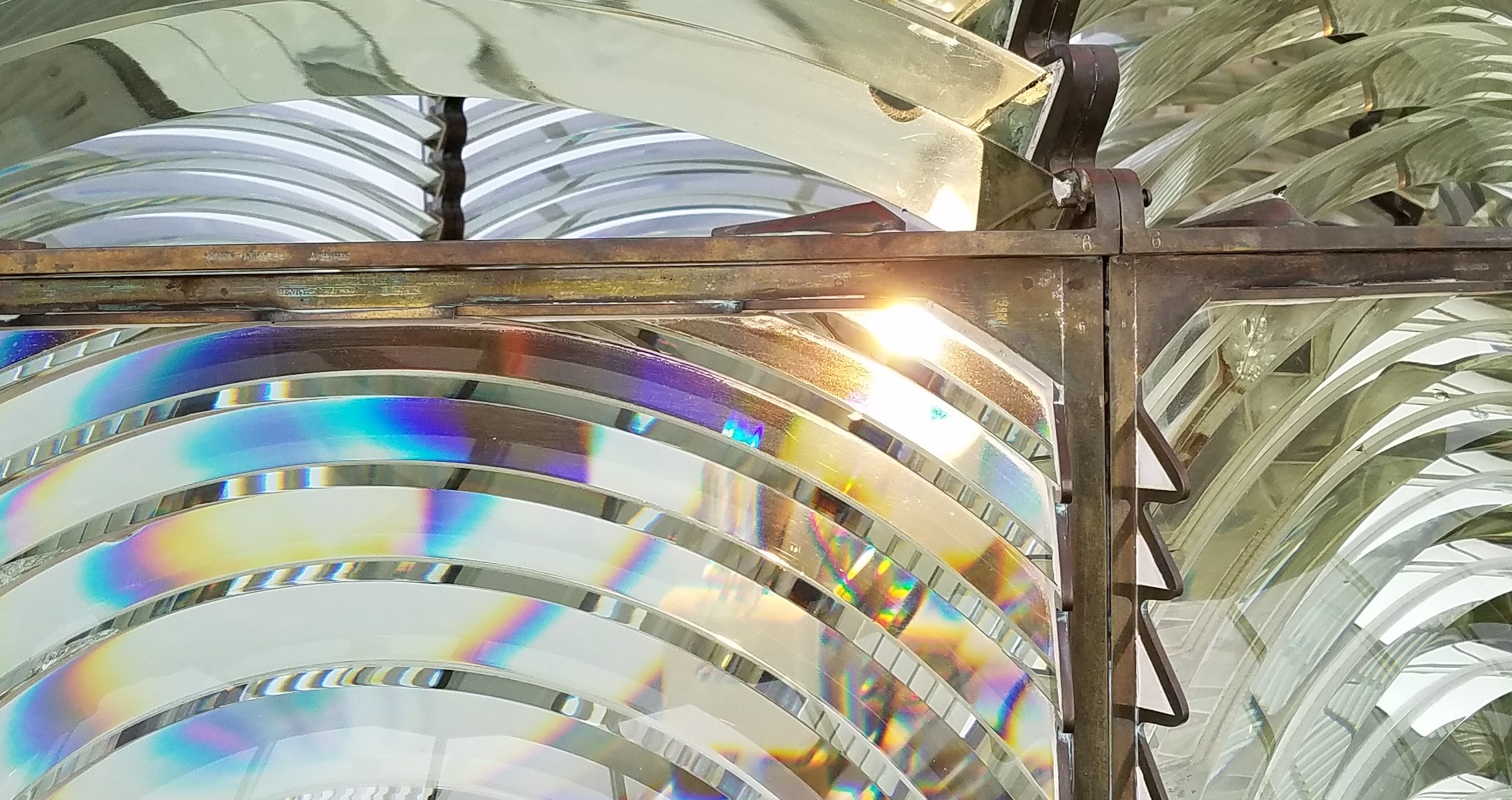
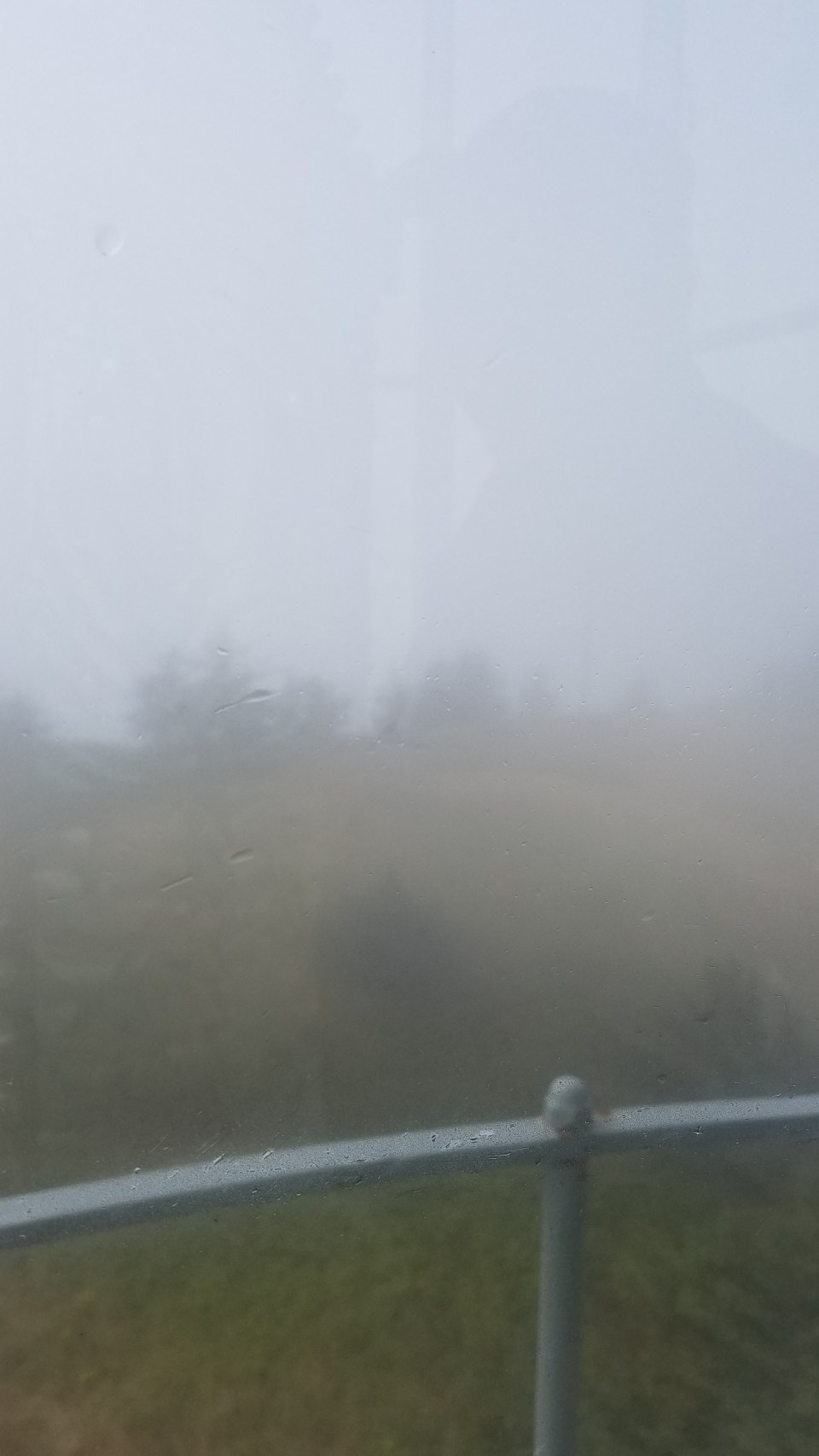
Originally, the light was run by lard oil from 1870-1887 and then mineral oil from 1887-1936, both dirty and smelly so it required a lot of work to keep the light clean. They had to carry containers of fuel up the windy stairs where they spent their nights searching the four windows for signs of ships (we could see nothing today because of the mist) and making sure the lamp stayed lit. We were able to climb the winding ‘floating’ original iron stairs (they are not attached to the structure) up to the fuel room and then to the light tower. We saw the Fresnel lens up close and personal and it was stunning. In the old days, the light was shaped like a cylinder and was refracted using shutters; each lighthouse having its own unique ‘shine’. In 1936, with the arrival of electricity, the wicks were replaced by light bulbs, the shutters replaced by a generator that constantly turns the new cone-shaped light. Also, there is a curtain in the tower because on sunny, clear days, the light is strong enough to start a fire down below.
Cape Blanco had three light keepers: 1 Head Keeper and 2 Assistants. James Langlois served for 34 years, the longest serving lightkeeper at Blanco; arriving in 1876 and leaving in 1919 upon his retirement. He arrived with his wife Elizabeth and son William as Assistant Lightkeeper and was promoted to Head Lightkeeper in 1882. The three lightkeepers and their families all lived under one roof for 34 years until a Head Lightkeeper’s residence was built in 1910. The Head Keeper’s residence was fortunate enough to have a privy but the Assistant’s still had to use the outhouse! Fireplaces and oil lamps were the only source of heat and light and the nearest town was a full day journey away on horse.
When we left for our visit the sun was shining and it was in the 70’s. As we approached the Cape, the sky became foggy and the temperature dropped. We thought at first it might be smoke from the forest fires here in Oregon but we soon realized when the winds hit us that it was the mist from an angry ocean. I was more than a little frightened being on the scooter; we just about got blown over when we got off it. The anemometer registered winds at 35 miles per hour. And this was a typical summer day on the Cape. Which brings me to what the Langlois and others dealt with: howling winds, thick fog and torrential rains – ALL the time. They lived here full time so they grew food, raised livestock and had to manage all their daily chores in these conditions. They were stuck; isolated. No one around; nowhere to go and dealing with the awful weather nearly every day. Sure, ships would come every month or two to deliver mail, paychecks and supplies but other than that, the nearest neighbor lived 3 miles away (this was actually an Assistant Light Keeper, Hughes, who had money and did not like sharing a residence with two other families so he built his own home nearby). Why would anyone sign up for this you ask? Well, in those days, there weren’t too many ‘long-term’, high-paying jobs (they made about $1,800 a year which was supposed to be ‘rich’ in those days). These were federal jobs so there was an allure and a respect that came with the role; they wore uniforms and kept to a rigorous schedule otherwise lives were at stake.
Now, when I see a lighthouse, I think of those men and their families and what they endured to keep watch over men on the sea. It makes me like these beauties all the more.
[Here’s a good laugh for you!]
View from the first floor up to light.

The (new) light. Made of glass. The original reflections where made with shutters and an oil lamp, now we have light bulbs.

View from second floor ‘lookout’ where the men would spend their overnight shifts making sure the flame stayed lit and watching for ships. This was our view the day we visited.
Coming down the ladder to the third floor.

The original winding iron floating staircase.

The lighthouse and the fuel room attached. The residence was torn down.
The light again.


My niece Megan asked us earlier on in our trip, which was our favorite park. I am going to have to update my answer. Earlier on it was the Grand Tetons of Wyoming, those magnificent peaks surrounded by lakes and shrouded in magnificent sunsets. It’s tough to judge beauty but I think I’m going to have to now give the edge to Glacier National Park in Montana. It wouldn’t be right to try and do a head to head comparison as those efforts would be fruitless and confusing. Would you compare the Sistine Chapel to the statue of David? Overall though, I hope this description of the park at least points out some of the more breathtaking features it has to offer, and which led me to change my opinion.
Like many of the parks in the Rockies and Northwest, areas of the park, sometimes significant areas, have been destroyed by forest fires. Some of these fires are started by carelessness and others just by lightening strikes. Needless to say, the increasing temperatures as a result of global warming, the drought the west has been experiencing, and the death of many tree’s by disease like the devastation caused by the pine beetle which leave a rich supply of dead, dry wood on the forest floor and above, have created conditions that make these fires more likely. The most recent forest fire to burn through Glacier occurred in 2015. It is easy to see the area’s affected by this fire. For one, all you see in the area in the way of evergreens are very small saplings, just getting their start. They are surrounded by lush meadows of wild flowers, grasses, and small bushes. This is the rejuvenation of the forest undergrowth. Fires are actually a good thing for the forest. The other thing you see are the trunks of the burned trees that are still standing and didn’t burn to the ground. They are a ghostly white. The fire charred their outer bark that eventually fell off and exposed the woody part of the tree below. At that point, it was the sun, wind, and rains that bleached the wood it’s ghostly grey/white color. They stand there, ghosts of the ancestors of the forests that will eventually replace them. Eventually they will decompose and feed the growth of the new generations. The fire restores the forest in this way. Certain pines seed cones require fire in order to open them and deposit the seeds. Certain plants like Bear Grass and Fire Weed and flowering plants whose root systems (Rhizomes), survive the fire underground and then explode with new growth once the tree cover has been removed by the fire. It’s all part of the grand plan!
Similar to the other parks located in the Rockies that we have visited (4th), it also offered an abundance of amazing flora and fauna. We encountered mountain goats, Columbia Ground Squirrels, Deer, Marmots, Black Bears, birds, and an amazing offering of flowers and insects. No Griz did we see, however, it was pointed out by a Park Ranger that of the 1,000 odd bears that make the park their home, approximately 300 are grizzlies. They take protection from bears up here seriously, and that includes making noise while hiking, keeping all foods and aromatic substances like soap, etc. in a bear proof canister away from your tent, and carrying a can of your trusty bear spray on your belt at all times. Lucky for us and lucky for the bears, an encounter didn’t transpire. Viewing these magnificent creatures from a distance however continues to be one of our top priorities throughout the trip. We did get treated to a real thrill upon leaving the park and that was a viewing of a wolf. It was in the morning of our last day and we were driving on a semi remote stretch of road with meadows and pine forests and as we rounded a bend here comes this black wolf crossing the road about 40 yards in front of us. It stopped about 20 feet into the meadow, looked over at us, and then proceeded to trot up and into the tree line! We were like a couple of giddy and excited children. They are more common to be viewed in Yellowstone and we were disappointed at not getting the chance to spot them there. They aren’t like the elk or deer that have become accustomed to people. They remain shy and elusive so this was truly a treat.
I need to make a footnote to this blog entry because I am writing it almost a month after the visit to Glacier. I took notes on our stay there, which will serve as the kindling for this fire; however, it’s not the same as writing it when the experience is fresh. I’ll have to fill in the missing blanks here from a distance and I hope I can do this magnificent park justice. The delay is the result of finding too little time to write when there is so much going on. Regardless, I’ll do my best to recapture the impact this park had on us here.
The impact of this park can be accounted for in two of the hikes that we did, which are excellent examples of what the park has to offer. Both of the hikes had trailheads that started out of the Many Glacier campground area, located in the northeast corner of the park. The first was a 12 mile round trip hike up to the Grinnel Glacier. It started alongside a beautiful lake and proceeded to climb up from that point through forests, sub-alpine ecosystems and finally up into alpine ecosystems. Along the way, we were treated to an amazing array of wild flowers that seemed to be bursting with color and at their peak of blooms. They carpeted almost every inch of open space and meadow. Even at the highest altitudes, we were accompanied by dozens of colorful butterflies, bumble bee’s, honey bee’s, flies, tiny spiders, chipmunks, squirrels, birds, and marmots. We had encountered mountain goats in other parks who spent great amounts of time licking rocks in order to get the much needed minerals into their diet that the sparse alpine environment didn’t offer through plants, but, here was the first time that we saw this same behavior with a marmot. The path up took us to a point along a steep cliff where a waterfall came down from above and right over the path. We came upon a rather large marmot, busy licking the rocks and seemingly oblivious to us as we stopped to observe him and then pass on. There was a series of three lakes that were below us as we ascended the trail and as the sun rose over the eastern ridges of the mountains to our left, it brought about the reflection of the surrounding peaks in the lakes below. As the sun grew higher in the sky, the images reflected in the lakes became as clear as a postcard, only occasionally obscured when a lone cloud happened to pass in front of the sun. Upon reaching Grinnel Glacier, we were treated to a magnificent view of the valley below through which we had just climbed. There below us were the beautiful blue/green waters of the three lakes, the second of which was in a subalpine ecosystem and the third of which was an alpine lake. The sky was a bright blue and the suns rays were warming our faces and all that surrounded us. At the top of the trail there was a final steep climb across and up a snowfield that took one to a beautiful waterfall, crashing down off a high cliff, and then over a second step of stone, and into a stream that ultimately fed the lakes below. It was all so breathtaking. We stopped here for lunch to soak in the view for as long as we could. P, B, and J’s never tasted so good! We enjoyed the same vistas a second time on our way down and so spectacular were they, that we felt “high”, and fortunate, when we finally made it to the parking lot, our RV, and Jackson who was patiently waiting for us.
Our second hike out of the Many Glacier area was the following day and was a 10 mile hike that would take us to what was called Iceberg Lake. As with most hikes, we got an early start in order to avoid trail traffic and to get back to the RV and Jackson before the afternoon sun made it too hot. Prior to today, the previous days hike to Grinnel Glacier became the “can you top this” hike of the trip, but today’s hike to Iceberg Lake was about to give it an even run for its money. Both of these hikes took us up trails that led up out of valleys and ultimately to the alpine areas above them. Both valleys were surrounded by ridges of vertical granite that stood like sentinels over the beauty below. The ridges stood straight and firm against the blue sky, powerful and stoic like the walls of a mighty fortress. We were again treated to un-immaginal beauty as the trail took us past the tree line and into expansive alpine meadows exploding with a blanket of color provided by alpine wild flowers that took our breath away. No description can I provide here that can capture its beauty, or could feed ones imagination to recreate its wonder without seeing it in person. Alpine lakes, granite sentinels, a sea of blue above, waterfalls, all surrounding expansive meadows of purples, whites, yellows, pinks, blues, and…………. Its beauty was mesmerizing. Like the sirens of Ulysses, I should be tied to the trunk of a ponderosa pine here and allow the magnetism of this visual masterpiece have its way with my mind and my soul, lest I stay here all day until the night falls, spell bound by the grace that was before us. Is this too great a height of comparison to attest to the vision before us? I think not, but I will defer to you, when you too have had the good fortune to gaze upon it firsthand as well. But even then, if it’s vision doesn’t carry you away like it did mine, I will have to attribute it to a lack of sun, or something personal that has occupied your mind in place of your surroundings, or the pitiful misfortune of being blind!
When we reached the “top”, our physical expenditure was again rewarded with a magnificent visual splendor that our imaginations could not predict. Here was a crystal blue, alpine lake surrounded by those granite guardians that stood guard over the valley, with waterfalls cascading down the cliffs and filling this pure, crystal pool in which were a hundred or more floating chunks of ice. Some were small, and some the size of small trucks, and each had a portion above and a portion below the icy blue water line, the submerged portion easily seen through the clear pool in which they floated. Along the shoreline of this amazing vista, we again stopped for lunch and continued to devour the splendor before us. Two days in a row now we have been witness to nature at her finest, captivated by its beauty, its expanse, and its power. We feel privileged and blessed. I hope that everyone can get here at one point. I hope that every child can get here so that the seeds of experiencing nature can be planted early and they become natures protectors as adults. And if they don’t agree with me that Glacier was the most amazing of the National Parks, then go ahead and protect that one too.
I can’t criticize those who choose to exercise through the means of a gym membership. But I would have to say that a treadmill or barbell has no legs to stand on when compared to a hike through nature that burnishes not only your muscles, but your spirit and soul as well. To hike for 5 hours with the sun on your face, gentle breezes providing refreshment as well as carrying the fragrance of pine forests and wild flowers, the surprise of coming upon all variety of small/large mammals, exotic birds, butterflies, and of course the constant stimulation of the overall beauty of nature that can only be experienced in its totality by being out in it. Yes, our hamstrings and our quads burned, yes, we sweat and replaced our lost fluids by guzzling water, but, at the end of the day, it wasn’t our muscles that received the greatest growth, it was our souls. Our spirits soared, we conversed for hours about what we had seen, and our tightening muscles and burned calories were but an afterthought, so insignificant to the greater gain. These hikes are so much more.
There are 25 glaciers remaining in this national park, and there were upwards of 150 back in the 1800’s. They are disappearing, the victims of global warming. It is hard to imagine global warming happening at this pace that doesn’t have the fingerprints of human activity all over it. The normal cycles of global warming, with the exception of catastrophes like asteroids hitting the planet was spread out over thousands of years. Our warming trend is less than 200 years. It is estimated that at the current rate of melting, the remaining glaciers will all be gone in approximately 10 years. The detrimental effects of their disappearance are already being seen. As the temperatures rise, the tree line of the forest is moving further up the mountain, and taking over the alpine ecosystems. In essence, it is replacing these ecosystems and the plants, flowers, animals, insects, birds, etc. that make this alpine environment their home, and depend on it for their survival. As the glaciers disappear, the melting of ice during the summer months will slow and then end, threatening the streams and the rivers and lakes at the lower elevation and all the life that depends on them. The lower elevations will then be prone to severe droughts. The end of this melting run-off will threaten the insect larvae that live on the rocks in the streams and are food for fish, birds, amphibians, etc. As the creeks dry up the plants that depend on this source of water and live along the banks and the wetlands the streams create, will dye off and the small and large mammals that depend on those plants will be threatened as well. It is the domino effect to a devastating degree. If there is a chance to prevent this, then how could any person of sound mind refuse to take action? Where are the voices that are necessary to do what we can, while we can, to protect these amazing places that nature provides us? How many voices would be heard if we were to lose the Mona Lisa in 10 years? How about the Sistine Chapel? The statue of David? The contents of the Museum of Modern Art? The Louvre? If there were a chance to save this trove of mans most inspiring renderings from its potential loss, would not the world unite in its defense? Why then can so many stand by and let the greatest works of God disappear? Anyone who has spent any time in these parks, and for that matter, any of Mother Natures many locations from backyards to State Parks, etc., has been touched by her spirit. Anyone who has swam in an unspoiled River. Walked a trail through a forest with maybe only the sound of their feet to disturb it. Sat upon a mountain peak and watched as the sun dropped low and pulled the shrouds of night across miles of forests. Has sat in a meadow of wildflowers and dreamt to the sound of bee’s and the dance of butterflies. Listened to the sound of leaves and the sway of trees as a soft breeze passed through them. Watched as an eagle circled down to the surface of a lake and effortlessly snatched out a fish to bring back to its fledglings. These are the owners of the voices we need to hear. Introduce children to these wonders early in their years, as they will be maybe the last generation that can save them. Nature is a powerful elixir and once exposed to it, it weaves itself into your memory and your soul. It helps us to be human. Take them on the trail, to a river, to a peak, and to the ocean, and let them soak it in. That is what is needed, for how tragic it would be, for this generation to utter the words, “I remember when…”, to a child of theirs who will never be able to know.


It might have been a case of biting off more than we could chew. Desolation Peak was known to be a challenging climb in North Cascade National Park. Not technical and certainly possible to do in a day. But it was a long, uphill climb and it was steep. Although it was basically a 12 mile round trip from the parking lot and back, it was the final 4.8 miles up that gave us pause. That 4.8 miles was a vertical distance increase of 4,400 feet. That’s a lot of switchbacks. In addition, we weren’t just going with day packs as most people were. We planned on camping out up top so we were also going to be lugging packs in the 40-50 pound range on our backs. Also, there wasn’t any water on the mountain to be had, so we had to pack in the water for two people and a dog for basically two days. That’s a lot of weight and space. The final consideration was that it had been hot. Hot as in the high 90’s. With that as a backdrop……Yup. Sounds good. Let’s go. No problem.
To be honest, if this mission failed it was going to be on my back. I was the one pushing for it. For one, I wanted to do a challenging hike, even though I knew that Laurie wasn’t sharing my confidence and, we would be bringing the dog with us. (I might have been harboring some doubts as well but pushed them deep down where I could imagine they didn’t exist) Like I said, we had been doing some hiking over the last few weeks and like it is with a lot of activities you become engaged in, the more you do, the more you want to do. But you don’t want to keep doing the easy ones, you want to start moving up so to speak. So it goes with hiking. So, there was this aspect to me wanting us to do the hike. There was something else though. For anyone who grew up in the 60’s, there’s a chance you were bitten by the allure of Jack Kerouac’s book, “On The Road”. I did and I was. That book really grabbed my imagination of travel and America and people and experiences and hey….wasn’t that what we were doing with our journey around America too? Well, Jack spent 63 days as a fire lookout in the fire lookout tower that is situated right on the top of Desolation Peak. The mountain we could climb! During his stint there, he jotted out the notes for two other books he would go on to write which was “Dharma Bums”, and, “Desolation Angels”. So, this was a chance to hike up to the spot where Jack spent time and mental energy formulating and creating some fine American novels that were impactful to many in my generation. And the fire lookout hut was the same one now as it was then, with the exception that it had been painted and had a new cedar shake shingle roof, and of course Jack was no longer there. He had been replaced a number of times but the current lookout was a man by the name of Jamichael Henterly. More about him later.
We had the wilderness camping permit affixed to my backpack, which we had picked up from the Ranger Station the morning before. This would allow us to camp out on the peak and we were going to be the only ones there, with the exception of the current fire lookout. The Rangers were also nice enough to loan us (with a credit card as collateral) a bear proof food container. Hey, what’s a few more pounds in my backpack in order to force the bears to find their own food. The trailhead for Desolation Peak is off the banks of Ross Lake, which is an absolutely beautiful and semi remote lake in the North Cascades. We decided to take a boat from the road to the trailhead in order to not add any additional miles to the 12 we were already going to hike. The motor boat ride was gorgeous and we shared it with a group of trail runners who were going to trail run the 20 miles back to the lakes entry point after being let off. I get it. They used to do short runs and now they were going for something more. After they were let out on the banks, we traveled another mile or two to our departure point. It was about a quarter to ten in the morning and since we were on the west side of the mountain, the suns rays hadn’t yet reached down through the old growth forest. This was good as our climb started out in the still cool air of the morning. One thing though was immediately evident and that was the black flies. Their biting presence would be our constant companion throughout the 4 hour climb and into the evening until the sun set and the cold air and wind drove them into their beds for the night. The trail started out steep and not surprisingly, pretty much stayed that way for the next 4400 vertical feet. Now just to be clear one more time about this hike. There are seasoned hikers who pound out this climb without a second thought. We’re not them. I’d like to think though that even for them, this is a tough nut when you’re carrying a full pack on your back. So up we go. Our approach is to take a slow and steady gait with regular breaks as needed. Laurie has a tendency to overheat quickly and that could not only end the hike, it is medically dangerous, especially with our water at a premium. Jackson seemed to be doing fine and if anything, was expending way more energy than us as he tried to pull me ahead on the leash and made regular forays into the side brush in search of real or imaginary small mammals. As the morning wore on the sun’s presence became more pronounced and started adding heat as a factor to our ascent. Every step upward was a reminder to our hamstrings that they were being asked to carry the rest of our bodies and packs up the trail. Shortly thereafter they would start complaining about this unfair and uneven distribution of the workload. Further up we went and in spite of you wondering how close we were to the “top”, it didn’t help to look up. The top, although it was starting to seem that there really wasn’t one, was obscured by a thick old growth forest. So up we went. Now I knew that our campsite was above the tree line so when the tree’s started thinning out I took that as a good sign. Well, as with most coins, there are two sides and that was the case here as well. No tree’s meant that we were now completely exposed to the sun. It was already hot and now it was going to get even hotter. About this time something else became evident. The hike and the heat were starting to take a toll on Jackson. He was panting furiously and it seemed like every 25 feet now he was trying to crawl off into the shade of a bush and lay down. We really weren’t worried about how long it took us to reach the top but we were certainly worried about our pup overheating. Every significant bush or lone pine along the trail now became a stopping and cooling down point for Jackson and us as well. We gave him lots of water to drink and poured some over his head. He seemed appreciative of our efforts but his face said, hey, do we really need to keep doing this shit? You’re killing me here! I knew it really wasn’t going to do any good explaining to him that stopping here was not an option. One, it was a steep slope that we would not be able to set up a tent on. Secondly, the last thing he would want to do was to turn around and start the multi hour down hill return. So up we went. Then it actually happened quite unexpectedly. We came upon some hikers who were stopped on the trail and as we got to them they all started oohing and ahhing over Jackson. They saw our packs and said, hey, you guys staying over up top? We answered yes and they said how lucky we were and we were going to see the sunset and by the way, the campsite is about 20 feet up the trail. What? Did you say that the end was only 20 feet up the trail! Eureka! We made it!
We walked into camp which was a semi level hump on the mountain with spectacular views of the peaks and the lake below. There were two tent sites that were level and in the shade of the remaining pines that were pushing the limits of the tree line in order to give us some much needed relief from the sun. Off came the packs, up came the tent, rounds of water were shared all around and we laid our weary asses down on our sleeping pads. Inside the tent of course, much to the dismay of the black flies that continued to buzz around it, continually frustrated by the tempting smell of our sweaty bodies, with the nylon barrier that kept them from us. Oh this rest was sweet!
There is a deep satisfaction that comes from physical activity. It’s like the satisfaction that comes from finishing a hard days work, although the reward here was greater than any paycheck. They call the Northern Cascades the “American Alps”. I’ve been to the Alps and I can see why they say that about these northern Cascade peaks. The view from up here was absolutely gorgeous. It quickly made you forget about the physical slog you had just completed and the sore muscles that were going to continue to be sore for the next couple of days. The beauty of nature is mesmerizing. It grabs your attention and stops you in your tracks. Even when you turn away, it will turn you around and make you look again. Make you look at some of the details you might have missed the first time. It can calm you as it talks to you in the language that everyone understands. It makes you feel privileged to have witnessed it. It makes you feel part of something so much bigger. Here we were now, surrounded by peaks, many with glaciers or snow fields reminding us that we were further north now. In fact, we were almost into British Columbia, Canada. It was cooler now and the wind was distinct and refreshing. There are more glaciers in North Cascades National Park than anywhere else in the United States. Sort of begs the question why there’s another park called Glacier National Park a couple hundred miles east in Montana. Who cares. We’re here. It’s beautiful. We’re resting. We’re eating. We’re drinking. Well…….actually, we’re not “here” yet. You see, the campsite is actually about a miles hike short of the fire lookout tower. You know, the Jack Kerouack, On The Road, a writers inspiration for a generation, etc. location.
So, after dinner, we head for the true summit of Desolation Peak. Now the last thing we wanted to do at this point of the day was to start climbing a mile further up the mountain but needless to say, we weren’t coming this far to see some of Jack’s inspiration and come up short. After coming up over a false summit, we gained site of the top and the fire lookout tower. By now we were beyond the tree line and had a clear view of our destination. As we came up over the rocks and onto the top of Desolation Peak, we were met by a gentleman walking from the lookout towards us. Based on his green pants and hat, I took him to be the current lookout and asked him as such to which he replied that he was. He was lean and taught and his face was tanned and weathered, which was evidence of his time up here at the top. His name as I mentioned earlier was Jamichael Henterly. He had been with the forest service and a lookout for 24 years. I believe he had been the lookout on Desolation Peak for the past 6 years although I could be wrong about that. He was a perfect host not only for the summit of this magnificent mountain, but also for the US Forest Service. He welcomed us to his mountain top perch and shared conversation with us for the next few hours. He talked about the job and doing a 360 looking for “changes” every 15 minutes. He knew the names of all the peaks. This was his neighborhood and each of these peaks were the faces of his neighbors. He knew their shapes, their drainages, their ridges, the rock outcroppings, the way the forest came up from below before losing out to the higher altitudes. These were no less the identifying features of Jamichaels neighbors than eye color, hair color, height, and weight were of ours. He could tell if something was amiss on them similar to the way a mother looks at a child and knows they’re not feeling well. He knows when there is the sign of smoke, even before you have the time to look close enough to actually see the finest wisp of white. He is an expert. He knows his neighbors well and he can spot the smallest nuanced change in their contenance. He points out a fire that is burning 25 miles to the east of us. No concern at this point. It’s deep in the wilderness and they will let it burn until it burns itself out. He welcomes us into his lookout hut which is walled in windows. He talks about his wife, his kids, and his grandkids. I ask him if he is asked about Kerouac much and he says not that much any more. I guess there’s not many children of the 60’s doing the hike up these days. He knows the history of the lookout tower well and shares with us the dates of the last time it burned down and how the recent one was rebuilt in the 30’s. He does not feel lonely up here. He works 10 days on and then has 4 days off. He hikes out after 10 days and then hikes back in after 4. The same hike that we just did. It gives a new meaning to walking to work! Who needs a gym membership. Jamichael is in his mid 60’s but he looks much younger. I’m sure he could hike the pants off of people who are half his age. He does it for a living and it has kept him trim and taught. He’s comfortable up here in the mountains and he’s comfortable on the trails. Although this peak gets busy on the weekends, it’s much quieter during the week. I sense that time alone has made him an astute listener and an individual whose conversation and responses are well thought out and pointed. He’s got a lot of time to think.
As the hours pass, I find that he has an English degree but no desire to teach. He’s written some children’s books about fire lookouts but no one wanted to publish them. Too bad. He is also an illustrator and a damn good one too. He has taught illustration at a local college. He shows me a sketch book and some work he has done. Much of his subject matter is portraits and some of historical figures like John Muir and Jack Kerouac. Excellent work. He’s also an EMT who got his initial corpsman training during 3 years in the Army with the 101st Air Born. We talked about so much more but much of that was left on the mountain when we departed at sunset 4 days ago. We had come up for pictures of the sunset and to say we made it to Jack’s lookout station. Instead, we were treated to an unplanned and stimulating evening with Jamichael, and I must say, it rivaled if not surpassed our visit to the hut where Jack spent his 63 days, back in the day. As the sun set over the western peaks and the rays spent their last moments bathing the mountain tops in gold, we headed back down to our camp. We arrived as darkness was settling in and the first stars were making their appearance on a beautifully clear evening. It was cooler now and the wind was gentle but steady. The flies had bedded down for the evening and though the sun had set, there was still a golden pink sky behind the peaks in front of us. It was going to be a good night for sleeping.
A problem with our backpacking stove left us without coffee and oatmeal in the morning so we shared a granola bar, packed up our belongings, and started down the 4.8 miles to the shore of the lake. Going down is faster, but by no means was it easier. Our hamstrings relished the rest as our quads shouldered the burden of every step down the trail. The fatigue in our quads actually seemed more pronounced than the fatigue on the hike up and we found ourselves again wondering how much further before we got a break. As we got closer we could see the lake through the trees but the sight of water was deceiving. Switchbacks ensure that you ain’t getting there any time soon! Eventually we reached the trail head, dropped our packs and got to rest our aching knees and sore feet. We had a while before the boat was scheduled to pick us up so we spent it soaking our feet in the cold lake water, nibbling on some left over food, drying our sweaty cloths in the sun, and going for a swim.
I was thinking about Desolation Peak and why it was given that name. Desolation to me makes me think of barren and desolate locations like the north pole or sahara desert. This peak was none of those. It gave us a robust and fulfilling physical achievement and then rewarded us with spectacular vistas that individuals below are deprived of. Its summit was covered with a variety of beautiful and fragile alpine flowers of pinks, reds, yellows, and whites that was balanced against grey rock outcroppings and a variety of grasses. It introduced us to Jamichael who entertained us with an engaging and stimulating window on the mountains, fire lookouts, and a way of life that we can only imagine. Desolate? No. They should change its name but I hope not cause when you’ve been here, you want others who have been as well to know. It’s am experience worth sharing.


Well, we’ve fallen quite far behind with our postings. We’re currently out on the Olympic peninsula in Washington, and three parks removed from Yellowstone. It may be hard to believe but we continue to find ourselves in a time crunch to get the writing done. We’re either hiking or traveling and that makes it hard to find time to sit down at the computer. Well, time to catch up.
Yellowstone, as expected, was extremely crowded. If you didn’t get to viewing locations early in the morning you had to deal with mob scenes of tourists, and that’s if you were even lucky enough to get a parking space. We waited in line for four hours to get a campsite, after arriving at 6:30 AM to get in line! This would be a great park to visit in September, after families are off vacation and the kids are back in school.
That being said, it is an amazing park. It runs to the north of Grand Teton National Park and is continuous with it. It’s no surprise then that much of the flora and fauna is similar. There are Bison, moose, elk, deer, marmots, as well as many other small mammals, birds, and flowers. What isn’t the same are the geo-thermal attractions, which are astounding. It is a geo-thermal, earth science, paradise. From the geysers, hot springs, steam vents, and mud pots, it is truly a scene from a distant planet. What causes all these features is the close proximity of molten magma underneath the ground but close to the surface. Close to the surface is about 8 miles below. That may seem far but that is closer than most of the rest of the planet. The heat from that magma is what superheats the water that seeps down from the surface, causes pressure to build and geysers to spout. The centerpiece of Yellowstone is the middle of the park, which forms a caldera. This is a sunken area about 40 by 35 miles in size that is actually the location of the last volcanic eruption from below that occurred about 640,000 years ago. The level of the ground here actually fluctuates in height based on the upward pressure of the magma below! This caldera is where almost all of the geo-thermal features are located and where the magma below is closest to the surface. The caldera is continuously monitored by scientists as a future eruption is certainly possible.
As with all ecosystems, the abiotic features have a direct impact on the biotic and nowhere more so than in Yellowstone. The heat from the geysers, steam vents, mud pots, and hot springs allow grasses and other plants to grow throughout the year, including the winter. The air stays warm around these area’s and the ground free of snow. This unique area of the caldera is quite different than the surrounding land of Wyoming and Montana where the snow is deep and the winters frigid. That warmth and plant growth is what attracts grazing animals to the area like Elk, Deer, Bison, and other small mammals who come to take advantage of the warmth and the food. These animals in turn attract predators like coyotes and wolves. The predators chase the grazers who eventually run out of the caldera and into deep snow where they bog down and become the next meal. Ephydrid Flies live out there life cycle around the hot springs and are food for spiders, dragonflies, and other predatory insects.
The most amazing life however in Yellowstone are the microbes. The geo-thermal magnificence of this park causes many visitors to overlook the microbes. However, they are the source of not only many of its physical features, but also of its amazing colors. Additionally, they are truly unique among the microbes of our planet. There are very few places outside of this park and very few microbes that are able to live in boiling water or in boiling water that is also a strong acid. These amazing microbes not only live in these extreme environments, they thrive in them. So much so that normally you would need a microscope to see them, but here, they can grow in thick mats or sheets of feather like filaments that are visible to the naked eye. The microbes found in these environments include the Archaea which are the ancient bacteria. These are thought to be the first cellular organisms to appear on earth. Since early earth was not a place you would want to vacation to, (toxic atmosphere, super hot, lightening strikes, massive volcanic activity, etc.), it makes sense that these microbes would live today in an extreme environment similar to those early days of our planet. Thus, we give them the name “extremophiles”. Lovers of the extreme. The most extreme of the environments in Yellowstone are occupied by the Archaea. The microbes found here also include bacteria, eukaryotic cells, and protists. The more moderate environments are occupied by the bacteria. As most of us know, the Archaea and Bacteria lack a nucleus. The Eukaryotes, like the protists, have a nucleus and include different types of algae that thrive in the cooler waters.
Although these unique single celled organisms share the same neighborhood, there are significant differences between them. Some can live in water of temperatures that exceed 250 degree’s farenheight. Others can only tolerate water temperatures in the 90 degree range. Some live in waters with a pH of 2, which is similar to battery acid! Others live in environments with a pH of 8 or 9. They also differ from each other in their manner of metabolism. Some are photoautotrophs, using light as a source of energy and inorganic carbon for making organic molecules. Others are chemoautotrophs, using chemicals like H2S (hydrogen sulfide) as a source of energy in combination with inorganic carbon. H2S is a toxic gas that smells like rotten eggs due to the sulfur. Some metabolize the H2S and turn it into sulfuric acid (H2SO4)! Some of these organisms carry out a type of photosynthesis that does not produce oxygen. Instead, their waste product of this process is sulfate! The organisms here also include an algae called Rhodophyta, which is the most heat and acid tolerant algae we know of. Some use the toxic substance arsenic as a source of energy! Some use pyrite (fools gold) in the absence of oxygen as a source of energy. Some do photosynthesis during the day and then switch to fermentation at night. These are some of the most unique organisms found on planet earth and it is estimated that scientists have only uncovered 1% of this amazing microbial diversity that exists in the Yellowstone thermal features!
The colors in Yellowstone’s thermal features are also due to the minerals and microbes that live there. In general, yellow colors are due to sulfur compounds and organisms that utilize sulfur compounds in their metabolism. Dark brown/red and rust colored features usually contain iron compounds and again, organisms that utilize iron in their metabolism. Green is usually due to photosynthetic algae. Milky blue pools are due to high concentrations of silica, which is the substance used to make glass. In general, waters that are green or brown contain organisms living in the cooler waters, while waters that are orange or yellow contain organisms living in hotter or even boiling water.
In and of itself, this incredible diversity is something to behold with wonder and awe. These diverse microbes also have powerful and practical applications. Consider the following:
*These extremophiles are providing scientists who are searching for life on other planets with a signature of what to look for and what that life may look like. Not all alien life is expected to look like ET.
*Some are being investigated as an alternative fuel source as they can take chemical compounds and produce hydrogen gas which is a clean burning fuel.
*Some are being used to break down toxic pesticides that pollute our waterways and soil.
*An enzyme has been isolated from one that is being used in gene therapy and genome engineering. It has also been shown to cleave viral DNA.
*Some produce toxins that are being tested as a potential treatment for cancerous tumors.
*The enzyme Taq polymerase is used in the Polymerase Chain Reaction (methodology for making copies of DNA that is used in paternity testing and crime scene studies). This enzyme was isolated in 1968 from the bacteria Thermus aquaticus.
All of this from just 1% of the microbial species identified so far!
There are also some compelling questions that arise when studying these little guys that could lead to other significant discoveries. For instance, the metabolism of living things is mediated by enzymes and most enzymes are proteins. A proteins activity is dependent on the shape it takes. Exposure to extreme heat and or pH denatures most proteins, rendering them unable to control the reactions they are meant to mediate. What is it about the enzymes in these extremophiles that allows them to disregard these high temperatures and low pH and still function effectively? In addition, all cells have a cell membrane and cell membranes consist of lipids (fats). Fats dissolve at high temps and low pH but not these guys. Why? These questions are currently being researched but undoubtedly will provide scientists with understandings whose applications could be significant.
I won’t miss the crowds when we go, but I will miss the microbes! It was a truly unique experience to see and learn so much about these organisms that we are only beginning to understand.
Ants and the Trail
One thing that has been in common with all the National Parks we’ve visited so far is the abundance of ants on the trail. I go out of my way not to step on these industrious little critters as they criss cross the path in front of me, following some pheromone road signs that are leading them back to their nest, or some source of food. They don’t bother looking up at the amazing scenery, suffice it to say they may not even see it, let alone appreciate it. I wonder if they understand the concept of beauty. They seem pretty consumed by either defending their nest or bringing back food. I suppose that the fool hardiness of spending time admiring beauty is left to us humans. But of course they’re looking down and reading those little chemical trails their predecessors laid down which is as important to them as google maps is to us. Many of them are black. They look like carpenter ants and that would make sense given the abundance of fallen tree’s they have to make into a buffet. I think of the fungi and bacteria as the great decomposers/recyclers, but when it comes to wood, they don’t have anything on the ants. There’s also some that are both black and red. Don’t know their story but they too are busy crossing back and forth on the trail. Maybe they’re the result of an “inter-colored” marriage between a red ant and a black ant. I don’t know. Diversity is great though.
Like the ants, I spend a lot of my time on the trail looking down as well. Not following a trail of pheromones of course. In essence, it’s to avoid falling flat on my face, as it requires continued due diligence to navigate the many irregularities that the path takes. Tilt to the left, the right, backwards, drops of several feet, and of course the placement of dozens of odd shaped stones and boulders in a myriad of combinations that require you to be part mountain goat and ball room dancer. I also look down to try and avoid stepping on the little guys. It goes without saying, by looking down I protect my teeth but, I miss a lot of what’s around me. That’s what’s so good about having a trail mate like Laurie. When she’s looking up, I’m looking down and vice versa but we’re both quick to point out to the other some amazing scenery, animal, weather pattern, cloud, etc. that the other person is missing. It works out quite well. Between the two of us, I think we see about 50% of what’s around us. That’s still more than the ants, but they of course have no idea what they are not missing.
People
There’s something about traveling that brings out the yacker in me, and probably in other travelers as well. People who may not be prone to talking to strangers, seem to be more likely to do it when traveling. Maybe it’s the unsaid camaraderie of people who are on a journey. Whether it’s a week or a year, traveling the road seems to open us up. I love talking to the different types of people we encounter when we’re on the road. In restaurants, gas stations, on the trail, ranger stations, etc. It doesn’t matter where you are, there never seems to be a shortage of things to talk about, or, people to talk to. Old, young, north, south, unemployed, rich, middle class, immigrants, etc. They’re all on the road and they all have stories to tell and I’m more than willing to listen and, to match my talking with the best of them. We’ve only been on the road for a month but already there are too many encounters to recount that we’ve had with some really fun and interesting people, so I’m going to try and go back through my highly suspect memory to resurrect one of the notables. My favorite so far took place in a barbecue ribs/bar in Estes, Colorado. This town sits at the entrance to Rocky Mountain National Park and suffice it to say, it’s a very touristy type of mountain town. That being said, most of the eateries/bars are generally packed in the evening. The name of this particular barbecue joint we stopped at was called, “Smokin Daves”. No kidding. We really just went in for a beer but every table was taken with hungry tourists as well as the bar, most with several kids in tow. It was quite noisy. There was only one seat at the bar, which happened to be occupied by the purse of the woman sitting next to it. When asked if the seat was available, she turned up the attitude and the volume of her bother as if you were asking her to donate a kidney. Needless to say adjectives that start with the letter “B” immediately came to mind. She reluctantly removed her bag and freed up the seat. So we settled in, Laurie in the newly vacated seat with me standing next to her, to enjoy a cold brew. Now next to Laurie was an older couple. Old of course is a relative term so they were old compared to us. I’d say in their early 70’s. He was drinking beer and I think she was drinking rum and cokes. He, we would find out was Terry, and she was Linda. They appeared to have been there for awhile and were finishing up food they had ordered. When the woman whose adjective starts with a “B” finally left, we started a little chit chat about the mean woman who had been annoyed to pass Linda the pepper, and, relinquish her bags resting place to Laurie. Well, that’s all it took. Chit chat aside, now it was time for some entertaining conversation. You always start out with the basics like how long you traveling for, where have you been, where are you going, etc., and then it seems like you’ve known each other for ever and the good conversations begin. Terry asked me if I had ever heard of Air America. My eyes widened as I most certainly had. It was a “fictitious” airline that was a front for CIA covert operations during the Vietnam war. While Richard Nixon was telling the American people that the war was limited to Vietnam and wasn’t expanding, Air America was quite actively at work in Cambodia and Laos carrying out covert operations there. They were dropping supplies to rebels who were also fighting the North Vietnamese, rescuing downed pilots, and a number of subversive operations. Well, Terry was employed by Air America and was stationed in Laos and in fact, had just returned from an Air America reunion when we met him at Smokin Daves. He proceeded to tell us about how he was recruited from Pan Am to sort of run logistics and supplies for the Air America operations in Laos and although he never actually engaged in combat, he had his M-16 at his side at his location in Laos, all the time. Although I knew quite a bit about Air America, Terry shared a bunch of personal stories about the operations and also encouraged me to stop in at the University of Texas during our travels since they apparently have a research area there with videos and documents, etc. that I can go through regarding Air America. In between Terry’s story telling, the bartender asked them if they wanted another round, at which Terry said yes but that that would be it for his wife “Linda”. Well, Linda was having none of it and said I do think I’ll have another. Oh boy. Terry said it was going to be a wild night tonight. Little did he know that the bar tender would ask them two more times after that and Linda responded yes each time. Linda was laughing and was quite entertaining at this point. It was going to be wilder than Terry could imagine. After Vietnam, Terry continued to work for Air America in a variety of countries and while home on leave one of those times, fate decided to play its hand. Now it was Linda’s turn to lead the conversation. Now Linda had already been twice married at this time, widowed twice (didn’t get the details on that although it didn’t seem to be a red flag for Terry), and had twin girls. Well Terry’s mother thought it wasn’t much normal for Terry, who was now in his early thirties, to not be settling down with a woman so she convinced him to contact the widow in town. It seems that Terry knew of Linda but didn’t know what she looked like. It was typical for Terry’s mother to try and set Terry up with a date each time he came home for a visit. Terry , at this time, had access to free airline tickets and also to a beach house down in the Caribbean, so he invited Linda and her girl friend to come down with him for a visit. Having Linda “chaperoned” by bringing a friend to spend a week with this guy she really didn’t know was the proper thing to do. Terry told us that he had stocked the place with liquor and was looking forward to the visit. At the last minute, Linda’s girl friend had to drop out so Linda had to make a decision as to whether to go by herself. Now going alone to meet this “man” in the Caribbean was not viewed as being very proper and Linda’s father let her know that but none the less, she went. Linda was a confident and successful lady and that confidence extended to the decisions she made in her life. The one catch was that Terry didn’t know what Linda looked like. All of these arrangements had been done over the phone. So he was waiting at the small island airport watching the people disembark from the small plane and trying to figure out which one is Linda and here comes this gal with two huge suitcases which was probably 100 times more cloths than she needed but…… Well, the rest is history as the story goes and they had now been married for quite some time. Terry still hasn’t become number three and the way those two got along I doubt he will. She was quite tipsy at this point as were the rest of us, and we were all laughing and carrying on and were now probably louder than the rest of the crowded bar combined. What had started out as a stop for a quick drink on a hot Colorado afternoon turned into several hours of truly enjoyable conversation and laughter. We took some pictures and they gave us their address in Plant City, Florida and said that when we make it to Florida on our journey, to be sure to stop in. I hope we do. They were a couple of genuine and engaging people. And if we make it to Plant City and have to listen to their stories a second time, we’ll be all the luckier.


07.12.17
The drive through Wyoming to Grand Teton National Park was a mix of prairie and hills and then almost out of nowhere, there were the mountains. The magnificent mountains. Tetons, named after trappers who thought the pointy slopes looked like nipples (theory was they had been away from their wives too long!). We arrived around lunch time on the 12th. And, as usual, we did not have a reservation so we had to scurry through the crowds to the Ranger’s desk to see about finding a place to set up camp but since we had missed the early morning window we weren’t very optimistic. The Ranger’s told us that the only campgrounds with availability were at the north end of the park but that they usually fill up by noon. Luck was on our side; we got a site at Colter Bay Campground on Jackson lake (the significance was lost on Jackson). No hookups but it was perfect. Shaded, across from water and restrooms and private to boot.
Grand Teton park has gas stations, grocery stores, restaurants and its own medical center. Crazy. I’ve never been to a park like that (or at least I never knew it). Thursday morning, we continued our tradition of getting up early to beat the crowds. We had to make the 25-mile trek to Jenny Lake on the scooter. Well, at 7:00 am, let me tell you, it was COLD. I hunched down behind Dave as much as I could to hide from the wind and alternated putting my hands between my legs to keep them warm. When we got there our legs and asses were sore – 25 miles is too long on the scooter. We headed out to do the Jenny Lake trail which was a 7.6-mile trek around the lake with elevation. Almost immediately we ran into another couple coming from the opposite direction saying they had just seen a cub and were turning around because they were afraid of running into mamma bear. It figures, of all the times not to be prepared; we left our bear spray back at camp. All we had was one, yes ONE, bell and a whistle. And all the signs clearly say, bells are not enough to detract bears. We kind of shuffled forward although I was hesitating because I thought if we go any further up the trail this will be the end of us. I’m not normally worried about black bears because in places like this they are so used to people that unless you startle them or come across one with cubs they will typically leave you alone (maybe that is naive). But before we could make a decision, the couple, Alan and McKenzie from South Carolina (also traveling for a year – they started in January so were pros by now) proclaimed that we could go together since they both had bear spray and a bell and four people is better than only two. We walked in a line clapping our hands, stomping our feet, jingling our bells and I was playing some kind of awful tune on my whistle. And then, out of the bushes came something none of recognized chasing a chipmunk (turned out to be a martin – a rare sighting). Dave reached for the camera but I stood still listening and watching intently for bear. And then we heard it! Rustling in the woods – scrapping maybe of the trees? And Alan said: “That’s where we saw the cub”. Great! I can see the headlines now: “Couple killed four weeks into a 12-month trip”.
But, we hiked on with our newfound friends, with our bells and whistle, sharing stories about our adventures, the lessons learned, the great places to see. They, too, sold what they owned, quit their jobs, bought a camper, and hit the road! And we thought we were the only ones. We so enjoyed talking with them; we were sorry to have to part ways but they, after six months of hiking, were headed to Cascade Canyon, another 7+ miles further. We didn’t think we could make it that far. We hiked on without them and, still, I was afraid we’d run into a bear. But, there were so many people now on the trail – couples, families, parents carrying infants on their backs, that seemed to be completely unaware that they were in the ‘house’ of wild animals who don’t really appreciate us trespassing, that I felt a sigh of relief. I thought to myself: if there are bears, there are enough people around that the odds are in our favor (I know, bad karma). We never saw any bear that day, just birds and ants. Yes, ants. They are the thing we see the most of. Must be all the wood.
We headed back to Jenny Lake the next day to concur Cascade Canyon (now that we were warmed up). Only this time we took the boat across the lake to cut off about 2 miles of the trek. We came prepared with bear spray and my bell and whistle but we didn’t need it. We hiked up near Lake Solitude where there was a 360-degree panoramic view of the mountains. We found some shade and had lunch – PB&J sandwiches. On our return we made a wrong turn to Inspiration Point and added another 2 miles onto our already taxing journey. All together we did about 10 miles with 1,220 feet in elevation. Back to camp for our reward: BEER.
(Sorry, folks, having troubles loading photos right now. Check back again).


Martin


Jenny Lake


Cut Throat Trout

Cut Throat Trout


I love the Tetons. I’ve been here before and I’m always mesmerized by the way their jagged peaks reach up and are outlined against the sky. They are sharp and active and their presence cannot be outdone by the sun, the clouds, or the bluest of skies they stand in front of. They must be the youngins on the block because they’re not as worn down as the Rockies although they’re part of the same chain. Their massive peaks are sharp and rough and there isn’t the real appearance of hills to announce their next place in the geographic waiting line. No. The landscape is flat sage prairie, then lakes, and then there they are. The Grand Tetons. They reach up into the blue and reflect their magnificent presence on the many crystal clear, blue lakes that hug their base. You can drive their entire length and will be challenged to take your eyes off of them. They hold you and implore you to stay and watch the backdrop of a sunset be the final crown on their royalty.
You can tell they are related, these Colorado Rockies and the Tetons. They are tall and rough and they keep their snow hidden on towering peaks throughout the summer. They don’t give in to the summer season at all. They are the same as the Colorado Rockies in other ways as well. This makes sense. They are the same longitude as the Rockies, and their latitude really doesn’t differ that much. They seem to have roughly the same precipitation and they are roughly the same altitude range. So it’s not surprising that you will also see elk, and deer, and marmots, moose, and coyotes, etc. But, you’re also surprised by some new photo opportunities.
During a 7 mile hike around Jenny Lake. We were surprised by a Martin in the middle of the path. We hadn’t seen one before. It stopped and our first assumption was that this was some of the wildlife that had really become accustomed to humans. We were wrong. He was actually on the hunt for a chipmunk lunch as the hunted bolted from the bushes on one side of the path to the other with the Martin in close pursuit. The chipmunk reversed direction and went back to the other side and then made a quick right and the Martin shot two feet past and the Chipmunk smiled and made a quick exit into the underbrush. On the same hike, we were notified by some other hikers that there was a grizzly cub about thirty yards off the path on the right so they exited the area. They asked if we wanted to hike together, which we did, and soon became fast friends as we made our way down the trail making as much noise as we could to give fair warning to mama, wherever she may be. You don’t want to get between a mother griz and her cub and hungry or not, she will do you in quick. So while there aren’t any grizzlies in Rocky Mountain National Park, there definitely are in The Grand Tetons. The following morning we stopped along the road to watch a mother griz and her cub saunter across a field and into the tree’s, to quickly for me to snap a picture. That’s the way it is with wildlife. Timing is everything or at least a lot of the game. Another first for us in the Tetons came when we were swimming in Jackson Lake. Although it’s glacier run off fed, the water was amazingly warm enough for swimming. As we were standing on the shore we watched a line of 5 otters swimming about 50 yards off shore. Very cool. Unfortunately, no camera with us. We were able to get in a 7 mile and 11 mile hike while there, and there was an abundance of butterflies, especially at the higher altitudes. These beautiful and dainty little nymphs always give you just a glimpse of themselves before they bolt forth into some crazy flight pattern that makes you dizzy just watching them.
One of the interesting things about the Tetons is that the fault that caused the mountains to rise, is also causing the valley to drop. From an ecosystem standpoint, you have significant wetlands down below as well as meadows of sagebrush, grasses, and small bushes. This is followed by forests, sub-alpine, and finally alpine ecosystems. Again, it’s somewhat similar to RMNP. The lakes, streams, and wetlands ensure that there is a steady supply of mosquito’s in the neighborhood and even during mid-day, it wasn’t surprising to be accosted by a group of the hungry devils. It’s worth enduring them though as the vista’s of the Tetons are sure to please from dawn until dark.
The Rocky Mountains consist of basically 4 different ecosystems. “Riparian Systems” are located along the water whether it be streams, ponds or lakes in the mountains. These systems consist of a variety of plants, flowers, and grasses that thrive in this moist environment as well as the insects, birds, and mammals that also take advantage of the water for drinking and the plants for eating. The “Montane” is the ecosystem that exists below 9,000 feet. While this is a significant altitude change for a flat-lander like me, it is the lower reaches of the park. It is warmer and there is significant growth of grasses, Aspen tree’s, and Ponderosa Pines. Many grazing animals like Elk take advantage of this area as do squirrels, chipmunks, beavers, and otters. Between 9,000 feet and 11,400 feet we find the “Subalpine Ecosystem”. This is colder than the lower reaches, windier, and gets more solar radiation. This system has more moisture than the upper reaches as snow blows down to it from above. It usually gets up to 30 inches of moisture per year. The “Alpine Tundra” exists above 11,400 feet. This is truly a harsh environment. It is extremely cold and dry and receives powerful winds and intense solar radiation. It has extremely thin soil with limited nutrients. Only the best adapted of plants and animals can survive in this environment. The Bristlecone Pine for example grows with a twisted trunk to make it stronger and able to withstand the strong winds. It is the oldest single living organism on earth. Yellow-bellied Marmots hibernate up here and Pika’s store food all spring and summer to get them through the long, cold winters. Big Horn Sheep graze here in the spring and summer but head to lower climes for the winter months. You will find them licking rocks in order to get minerals for their diet that the limited plant growth does not provide them. This ecosystem is above the tree line which means that tree’s cannot exist in this environment. Tree lines form where the average temperature is approximately 50 degrees on average throughout the year. The thin and nutrient poor soil is also a factor. The growing season here is very short, approximately 6 weeks, so plants are small and tend to flower quickly in order to produce seeds before the snows come, and, to conserve energy. We were here in late June and the first part of July and all the plants at this altitude were in full bloom. Some plants produce a chemical called anthocycanin which is an anti-freeze like pigment that converts sunlight to heat, allowing the plants an adaptive edge against the cold. The Alpine and Subalpine lakes were carved out by glaciers during the last two glaciations.
The east side of the Rocky Mountains are dryer than the west side as the clouds that are heavy with moisture from the Pacific Ocean tend to hang lower and drop their rain on the east side. Because of the dry conditions, increased sunlight while we hiked at the higher altitudes, and the solar radiation, I had a serious case of “split and bleeding lips” that have only now begun to heal a week later and after about a quart of petroleum jelly applications! The intensity of the sun increases 5% for every 1000 feet gained in altitude. Relative to Pequannock, the sun is close to 40-60% stronger on many of the hikes we took.These mountains started to form about 65 million years ago when the Pacific tectonic plate and the North American plate expanded and met. The friction, heat, and pent up forces through the earth up and formed this spine that runs from Canada down into central America. The first record of ancient trappers coming to this region was approximately 11,000 to 12,000 years ago.
There are dozens of amazingly beautiful plants in the park which I’ll post pictures of but I haven’t had the time to identify them yet. One aspect of the park to note is that each afternoon the clouds thicken and there is a short sprinkle/shower.
One upsetting aspect of the park is the devastation to the pine forests that cover the lower mountains by the pine beetle. Hundreds of square miles of these pine forests are dead and the mountains are brown. The pine beetle is not an invasive species. The colder temperatures in the Rockies have basically been able to keep the beetle out of the mountains. With global warming however, the beetle has been able to expand its range further north and the results have been devastating. There are a variety of pine tree’s and the beetle prefers Pole Pines because they have a thinner bark which makes it easier for the beetle to enter the tree and lay its eggs. One possible solution for addressing this issue is to let forest fires take their course. The fires would burn out the dead tree’s and kill the beetles. It would also bring about renewed undergrowth of the forests and allow other tree’s to take root. For instance, Aspens require more sunlight and cannot thrive under a thick canopy of pines. With the dead trees eliminated however, the Aspens would flourish. The Aspens wouldn’t be killed off by the fires either as they have extensive root systems that store water and allow them to re-grow. The only reason that these “controlled burns” are not being allowed to take place however is because many people have been approved permits to build homes and now have expensive home in the mountains. The result is that the forests are not being given the opportunity to regenerate. Much of this information was discussed between myself and a ranger who also happens to live in the park.
Throughout the week while we were here, we had the good fortune to observe and photograph many of the animals that occupy these ecosystems. Many of the grazers like Elk, Deer, and Moose were observed as well as Mountain Goats on Mount Evans which is in the Rockies but south of the park. As I mentioned above, much time was spent searching out and photographing the plethora of flowering plants that thrive in all four ecosystems and even at the Alpine Tundra level, pollinating insects thrived as did birds.
Many of our hikes took us up trails between 8,000 and 11,000 feet. In the lower reaches it was very hot during the day and we welcomed the cool air that blew down the trail when it paralleled rushing streams. Some of the trails we climbed at the higher reaches required us to cross snow fields that would remain there through the summer and into their replenishment as early as September.
As with most of the parks we will visit on this journey, information is gathered through observation of the ecosystems on hikes; conversations with Rangers and park naturalists; Visitor Information Centers that have excellent displays; and information that is made available to visitors and is often included on maps that the parks provide to visitors.
 Claeys Road Diaries